Filmmakers Painting
Jean-Luc Godard © SIPA PRESS
Share:
This text initially appeared in ART PAPERS September / October 1998 Vol. 22.05

“The best stimulant, the best model, is always and again painting, painting- the paradigm for solitary art making; the painter-the paradigm for creation.”
– Jacques Aumont, L’Oeil interminable
In recent years there has been much discussion of the influence of painting on the art of cinema. With the growing scholarship there is an increased awareness of the importance of the older art for the newer one, as we learn that filmmakers as diverse as Louis Lumière, Robert Bresson, Derek Jarman, Agnès Merlet, Maurice Pialat, and Peter Greenaway were painters before turning to filmmaking. As scholars expand their approaches for thinking about the cinema, it seems helpful to know that Jacques Tati’s grandfather and father were picture framers, as we think about how Tati composed his filmic frames. Figuring prominently as well in this list of filmmakers with a background in the visual arts is Agnès Varda, who first studied to be a museum curator before becoming a professional photographer and then a filmmaker. Lately big name artists have been returning the volley, as Cindy Sherman, David Salle, Robert Longo, and Julian Schnabel all try their hand in the temporal art.
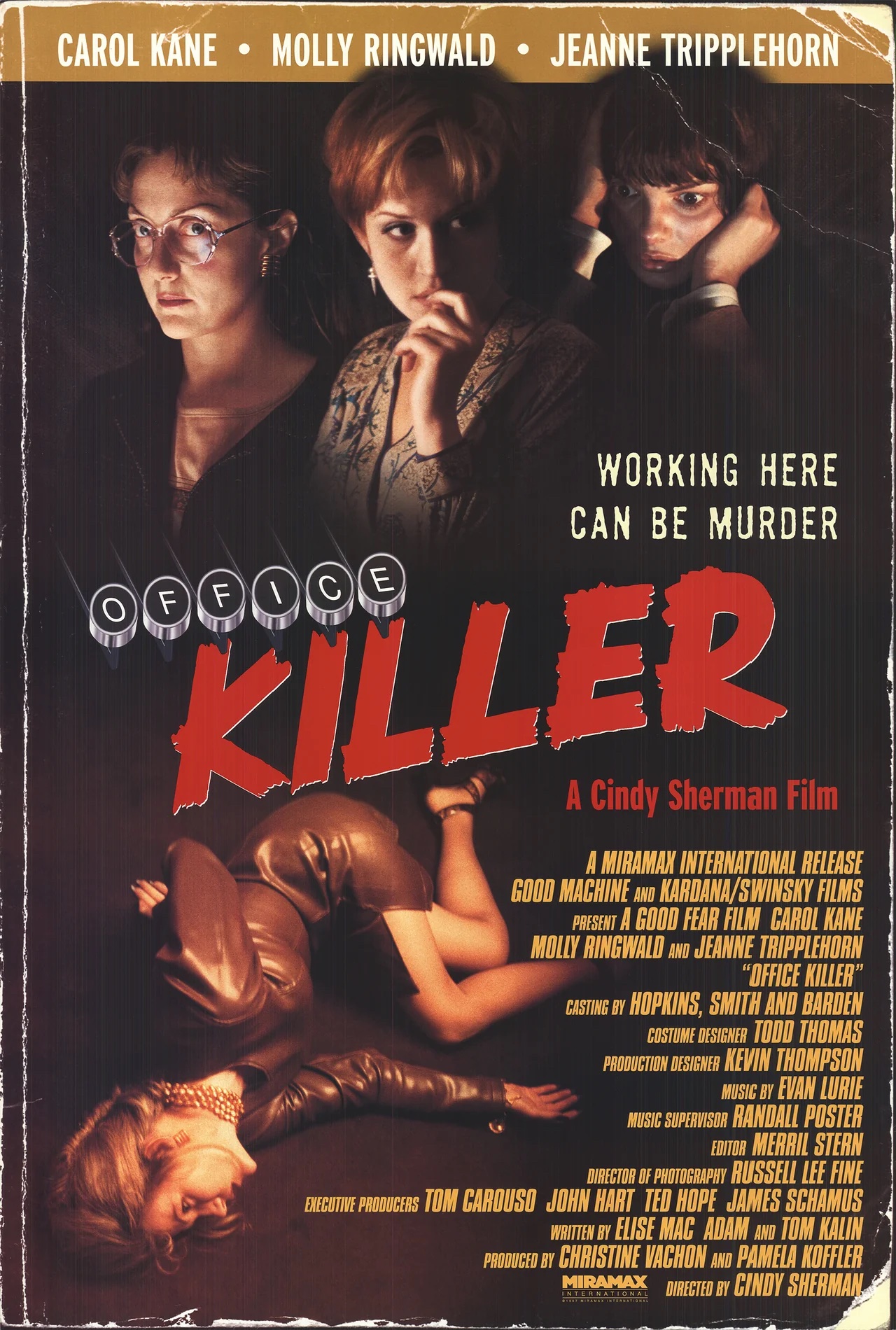
1997 Movie poster for Office Killer © Miramax, LLC.
But if the phenomenon of the filmmaker working like a painter is becoming a norm, it should be noted that the one filmmaker who most forcefully jump started this move was himself not trained as a painter. In the spring of 1960, during the release of Breathless, Jean-Luc Godard declared in an interview: “I work like a painter.”
With his pictorial rhetoric Godard both advanced and broke with the Cahiers du Cinéma collective rhetoric. The basic facts of his biography are well known. With a group of other young men, all ardent cinephiles, Godard consumed 1000 hours plus of cinema per year during the 1950s, regularly turning out reviews for Cahiers and Arts. Godard’s recent video opus, Histoire(s) du cinéma, is a testimony to those countless hours spent in Henri Langlois’s Cinémathèque française, a museum for moving images. In the 1950s, those young critics, attempting to win greater status for filmmakers, declared Alfred Hitchcock, Nicholas Ray and Samuel Fuller to be auteurs. By 1960, though, Godard wanted to be considered not an author of cinema but a painter of cinema. With the making of his first film, Godard became aware of the inadequacy of the writer as model. The type of filmmaking that he has perfected (low budget, improvisational) has little to do with the notion of shooting from a carefully planned script. It has more to do with the Action Painters’ notion of working quickly in the moment. And if Godard would be the first to admit that the cinema is an art of both showing and telling, he has also said that the function of showing takes primacy over the telling.
Now if film watching constituted the majority of Godard’s Imaginary, it did not do so in toto. Another aspect of his Imaginary, that well-spring from which artists draw their work, is the history of art. The many citations of painters and painting in his film criticism and then his films cue perhaps a less well known aspect of his biography. In addition to voraciously consuming moving images, Godard must also have been surreptitiously consuming static images, going to art museums and looking at art books. In a 1980 press conference, he declared art books to be his favorite books to travel with. They were even, he said, a reason to travel. Not surprisingly, Godard’s characters are often engaged in looking at art books.
Godard’s commitment to the visual has affected his filmmaking in a variety of ways. By the time he and the other Cahiers critics entered the historical record as filmmakers, genre films were torquing out of shape as the Hollywood studio system was breaking down. But while Truffaut and Chabrol were content to contribute to moribund genres, Godard declared himself uninterested in traditional storytelling. When in the mid-1960s Georges Franju suggested to Godard that a film needed a beginning, middle, and an end, Godard agreed, and added, “but not necessarily in that order.” It was as if those many many hours of film watching combined with how he watched them (darting in and out of cinemas to capture filmic images in surrealistic shards), created in him a need to make films in a radically new way. And a new way he has certainly forged over the course of the past nearly 40 years. It is thus no accident that Godard’s work was on view at the 1997 Documenta exhibition in Kassel, Germany, a venue where the most important artists worldwide are invited to show their work. As we close out the 20th century, Godard is becoming a model for serious artists, and his work correspondingly demands the attention of art historians.1 30 years after releasing his first feature and articulating a novel production method (“I work like a painter”), Godard was ready to address modes of distribution. In a 1990 interview, Wim Wenders asked him if he minded the falling off of his audience. Godard responded that he was holding out for a time when each of his images will be prized as highly as a painter’s canvas, where his film frames will be sold as individual pictures on the auction block. His jokey repartee suggests as well new terms for consumption—his films, particularly his more recent ones, demand a viewing of returns to apprehend them in any meaningful way. Since the mid-1960s, a doomsday rhetoric has rumored the demise of both cinema and painting. Godard’s genius is to have revived the one, by incorporating the other. The mad race that Franz, Arthur and Odile made through the Louvre in Bande à part (1964) signaled his ambition: Ars longa, cinema brevis.
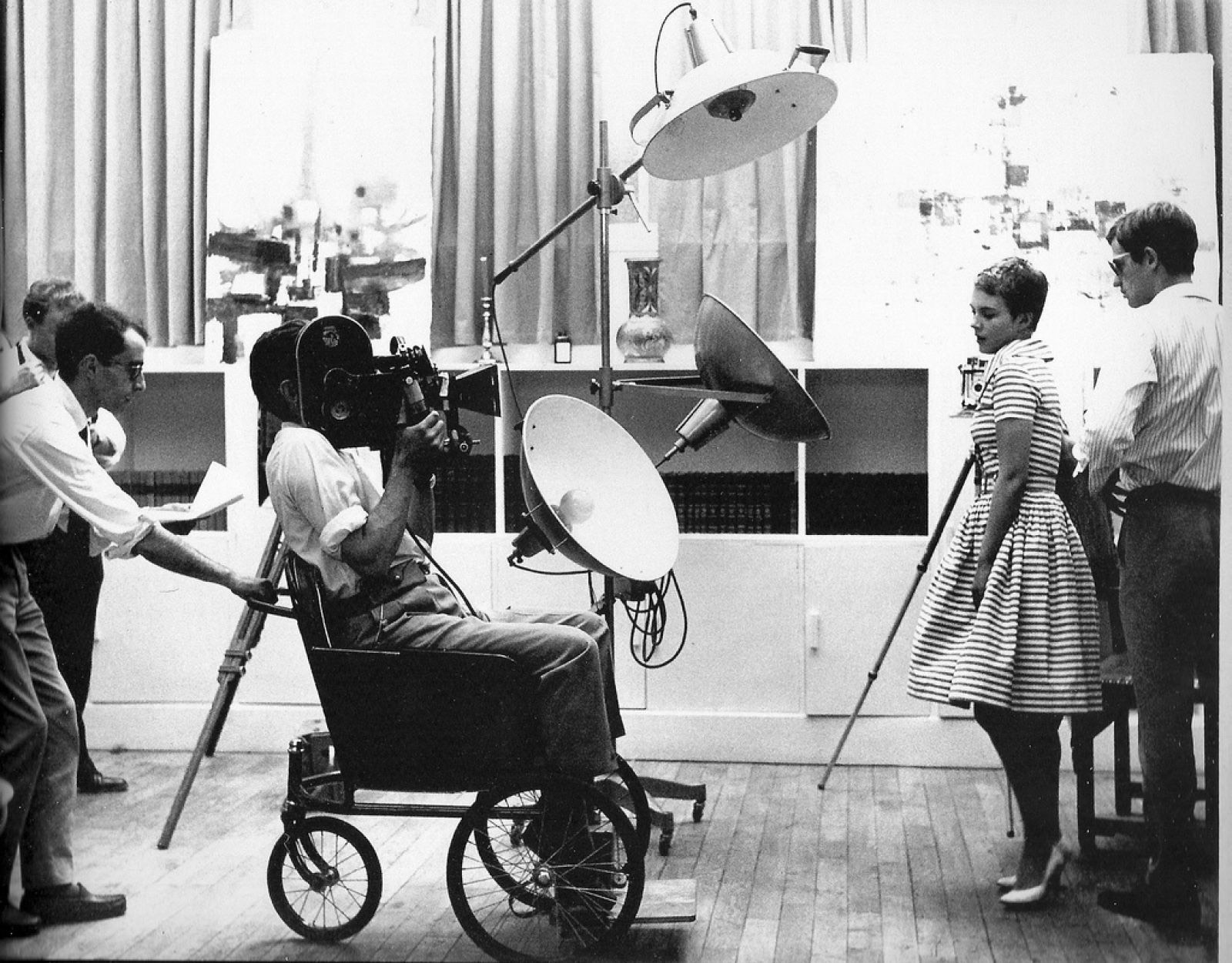
Jean-Luc Godard, Raoul Coutard, Jean Seberg, and Jean-Paul Belmondo on the set of A bout de Souffle [Breathless], 1960. Image Credit: Raymond Cauchetier.
Sally Shafto [at time of original publication] is currently in Paris researching the work of Jean-Luc Godard as a recipient of a Chateaubriand Fellowship from the French government. She is also assistant editor of The Image in Dispute: Art and Cinema in the Age of Photography (1997).
References
| ↑1 | In fact, Godard was receiving occasional attention in art journals already in the 1960s. See in this regard: Mel Bochner, “Alphaville, Godard’s Apocalypse,” Arts Magazine 42 (May 1968), pp. 14-17; Manny Farber, “Film,” Artforum 6 (November 1967), pp. 63-64; Manny Farber, “The Films of Jean-Luc Godard,” Artforum 7 (October 1968), pp. 58-61; Jean-Luc Godard and Alain Jouffroy, “Miner le terrain,” L’Oeil, no. 137 (May 1966), pp. 34-42; Max Kozloff, “The Inert and the Frenetic,” Artforum 4 (March 1966), p. 44; Toby Mussman, “Jean-Luc Godard’s Non-Endings,” Arts Magazine 42 (November 1967), pp. 20-22; Frank Whitford, “Pop in the Cinema,” Studio International (London) 173 (January 1967), p. 54. See also curator Meyer Raphael Rubenstein’s exhibition brochure, “Postcards from Alphaville: Jean-Luc Godard in Contemporary Art 1963-1992” (Long Island City, New York: The Institute for Contemporary Art, P.S. 1, 1992).
|
|---|