Sketching on Screen
Left: Film still from Summer / The Green Ray (1986). Image source IMBD
Right: Georges Seurat, Oil Sketch for “A Sunday on La Grande Jatte — 1884”. Image courtesy of the Art Institute of Chicago
Share:
This text initially appeared in ART PAPERS September / October 1998 Vol. 22.05
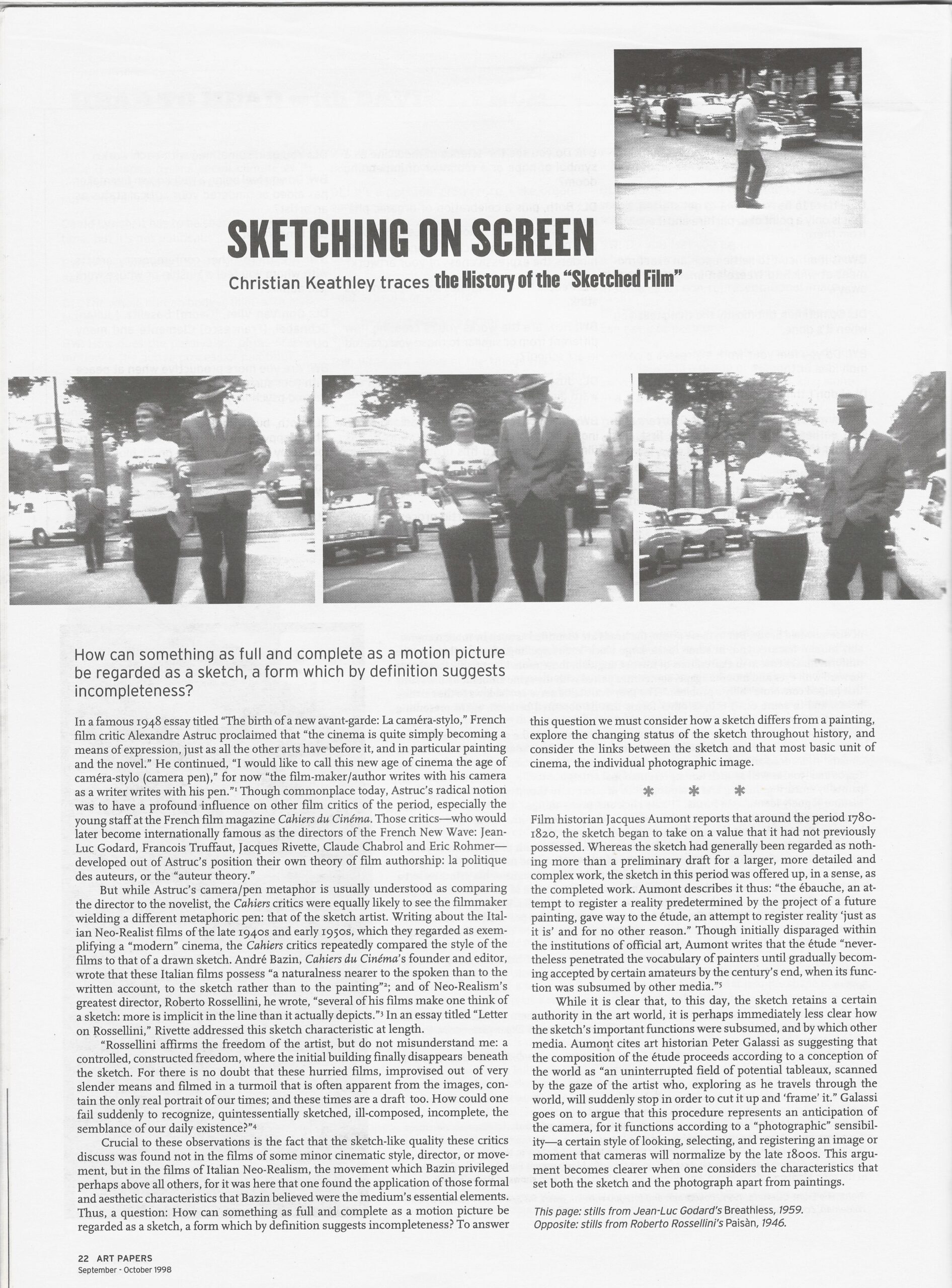
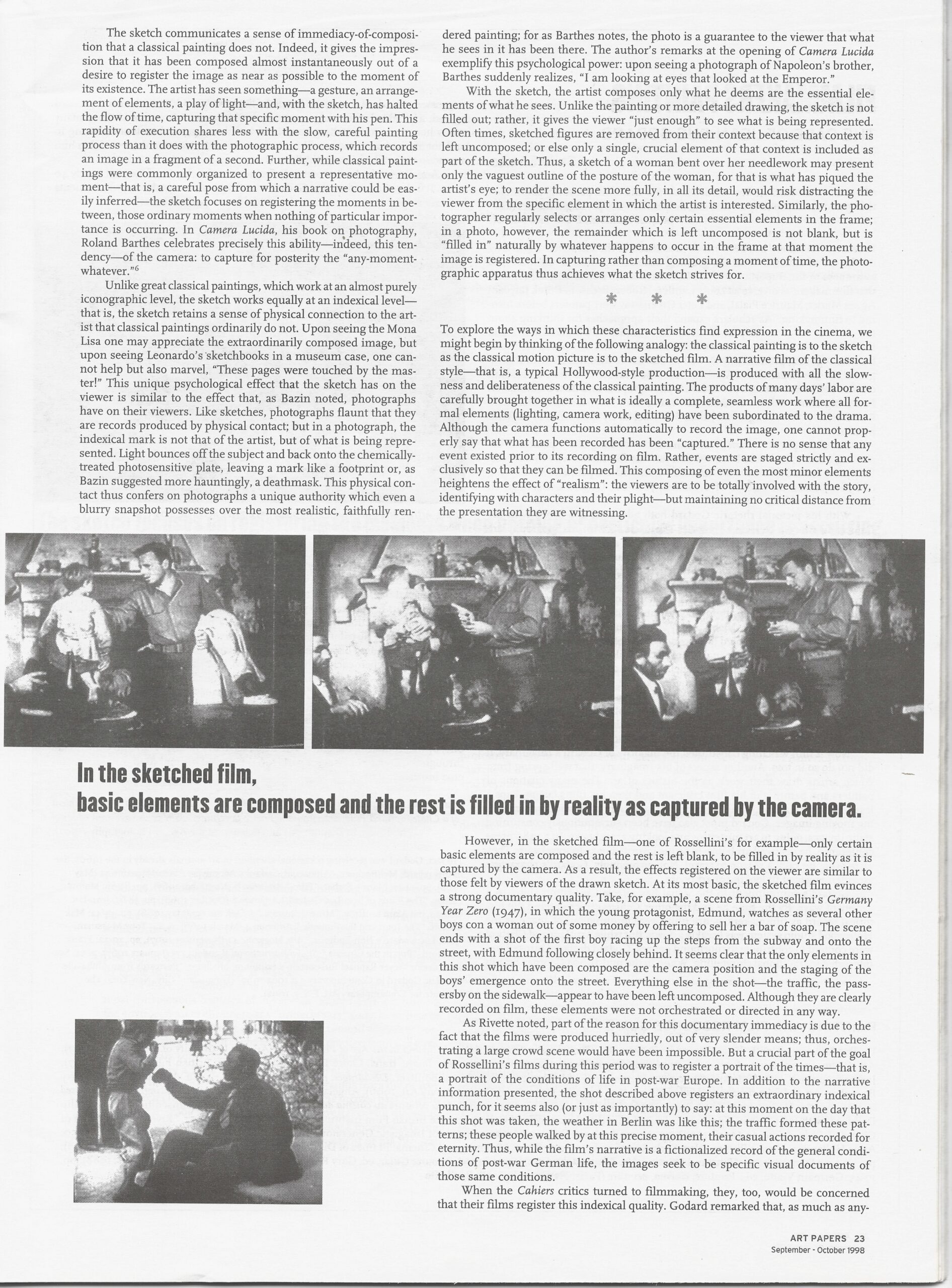

How can something as full and complete as a motion picture be regarded as a sketch, a form which by definition suggests incompleteness?
In a famous 1948 essay titled “The birth of a new avant-garde: La caméra-stylo,” French film critic Alexandre Astruc proclaimed that “the cinema is quite simply becoming a means of expression, just as all the other arts have before it, and in particular painting and the novel.” He continued, “I would like to call this new age of cinema the age of caméra-stylo (camera pen),” for now “the film-maker/author writes with his camera as a writer writes with his pen.”1 Though commonplace today, Astruc’s radical notion was to have a profound influence on other film critics of the period, especially the young staff at the French film magazine Cahiers du Cinéma. Those critics — who would later become internationally famous as the directors of the French New Wave: Jean-Luc Godard, Francois Truffaut, Jacques Rivette, Claude Chabrol and Eric Rohmer — developed out of Astruc’s position their own theory of film authorship: la politique des auteurs, or the “auteur theory.”
But while Astruc’s camera/pen metaphor is usually understood as comparing the director to the novelist, the Cahiers critics were equally likely to see the filmmaker wielding a different metaphoric pen: that of the sketch artist. Writing about the Italian Neo-Realist films of the late 1940s and early 1950s, which they regarded as exemplifying a “modern” cinema, the Cahiers critics repeatedly compared the style of the films to that of a drawn sketch. André Bazin, Cahiers du Cinéma’s founder and editor, wrote that these Italian films possess “a naturalness nearer to the spoken than to the written account, to the sketch rather than to the painting”;2 and of Neo-Realism’s greatest director, Roberto Rossellini, he wrote, “several of his films make one think of a sketch: more is implicit in the line than it actually depicts.”3 In an essay titled “Letter on Rossellini,” Rivette addressed this sketch characteristic at length.
“Rossellini affirms the freedom of the artist, but do not misunderstand me: a controlled, constructed freedom, where the initial building finally disappears beneath the sketch. For there is no doubt that these hurried films, improvised out of very slender means and filmed in a turmoil that is often apparent from the images, contain the only real portrait of our times; and these times are a draft too. How could one fail suddenly to recognize, quintessentially sketched, ill-composed, incomplete, the semblance of our daily existence?”4
Crucial to these observations is the fact that the sketch-like quality these critics discuss was found not in the films of some minor cinematic style, director, or movement, but in the films of Italian Neo-Realism, the movement which Bazin privileged perhaps above all others, for it was here that one found the application of those formal and aesthetic characteristics that Bazin believed were the medium’s essential elements. Thus, a question: How can something as full and complete as a motion picture be regarded as a sketch, a form which by definition suggests incompleteness? To answer this question we must consider how a sketch differs from a painting, explore the changing status of the sketch throughout history, and consider the links between the sketch and that most basic unit of cinema, the individual photographic image.
* * *
Film historian Jacques Aumont reports that around the period 1780-1820, the sketch began to take on a value that it had not previously possessed. Whereas the sketch had generally been regarded as nothing more than a preliminary draft for a larger, more detailed and complex work, the sketch in this period was offered up, in a sense, as the completed work. Aumont describes it thus: “the ébauche, an attempt to register a reality predetermined by the project of a future painting, gave way to the étude, an attempt to register reality ‘just as it is’ and for no other reason.” Though initially disparaged within the institutions of official art, Aumont writes that the étude “nevertheless penetrated the vocabulary of painters until gradually becoming accepted by certain amateurs by the century’s end, when its function was subsumed by other media.”5
While it is clear that, to this day, the sketch retains a certain authority in the art world, it is perhaps immediately less clear how the sketch’s important functions were subsumed, and by which other media. Aumont cites art historian Peter Galassi as suggesting that the composition of the étude proceeds according to a conception of the world as “an uninterrupted field of potential tableaux, scanned by the gaze of the artist who, exploring as he travels through the world, will suddenly stop in order to cut it up and ‘frame’ it.” Galassi goes on to argue that this procedure represents an anticipation of the camera, for it functions according to a “photographic” sensibility—a certain style of looking, selecting, and registering an image or moment that cameras will normalize by the late 1800s. This argument becomes clearer when one considers the characteristics that set both the sketch and the photograph apart from paintings.
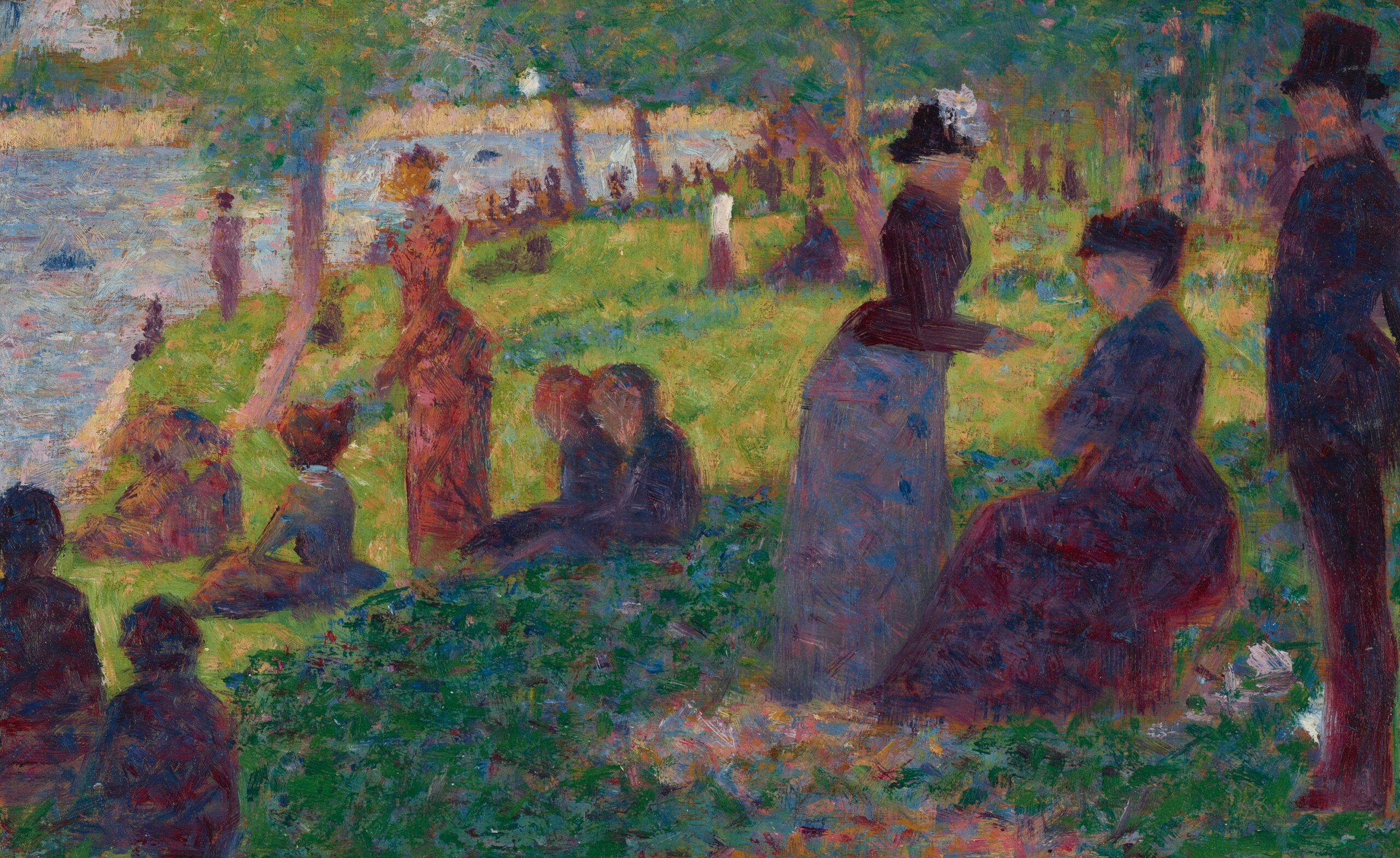
Georges Seurat, Oil Sketch for “A Sunday on La Grande Jatte — 1884”. Image courtesy of the Art Institute of Chicago

Attributed to Édouard Manet, Sketches of Marine Scenes (recto). Image courtesy of the Art Institute of Chicago
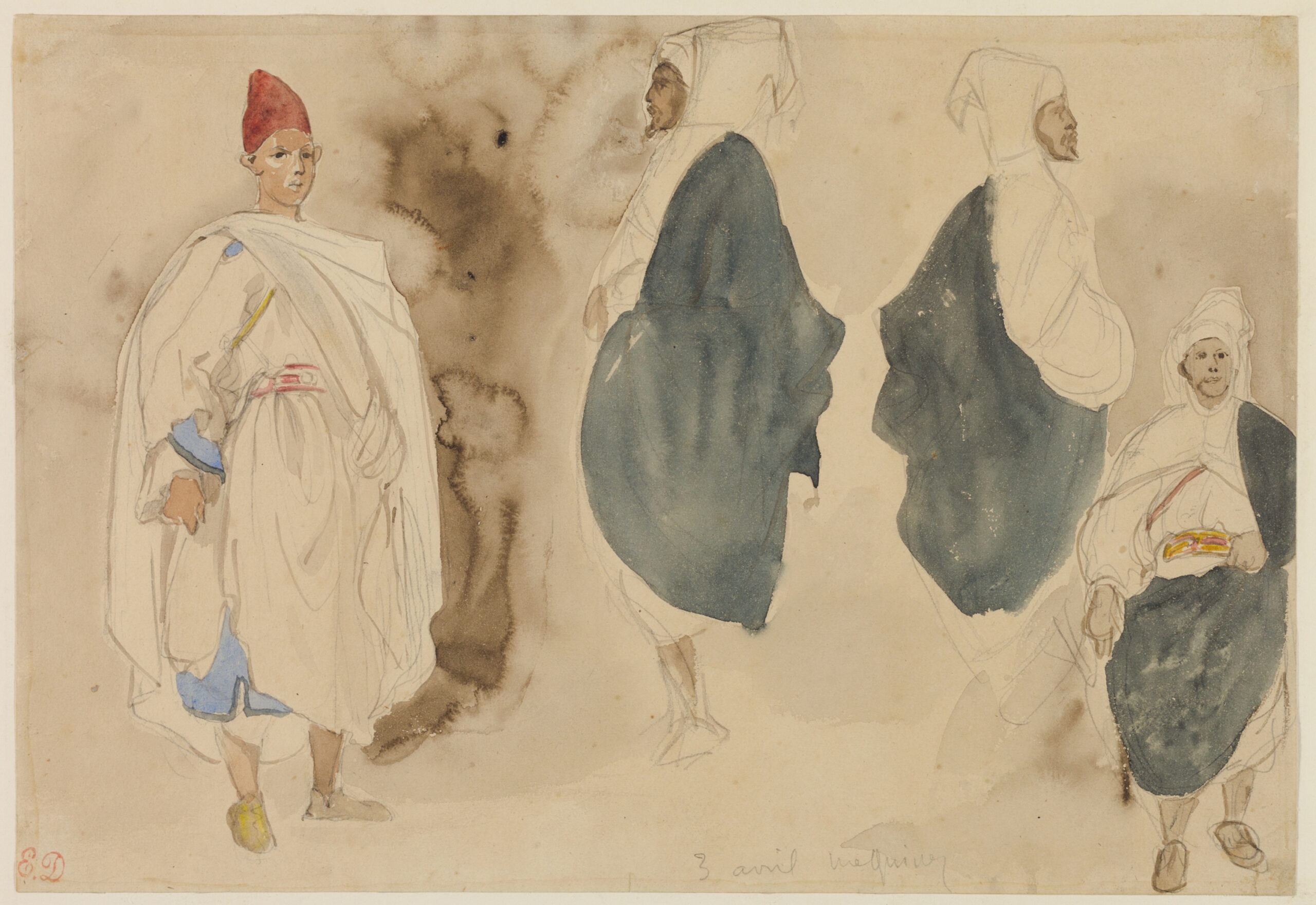
Eugène Delacroix, 1832. Image courtesy of the Art Institute of Chicago
The sketch communicates a sense of immediacy-of-composition that a classical painting does not. Indeed, it gives the impression that it has been composed almost instantaneously out of a desire to register the image as near as possible to the moment of its existence. The artist has seen something—a gesture, an arrangement of elements, a play of light—and, with the sketch, has halted the flow of time, capturing that specific moment with his pen. This rapidity of execution shares less with the slow, careful painting process than it does with the photographic process, which records an image in a fragment of a second. Further, while classical paintings were commonly organized to present a representative moment—that is, a careful pose from which a narrative could be easily inferred—the sketch focuses on registering the moments in between, those ordinary moments when nothing of particular importance is occurring. In Camera Lucida, his book on photography, Roland Barthes celebrates precisely this ability—indeed, this tendency of the camera: to capture for posterity the “any-moment-whatever.”6
Unlike great classical paintings, which work at an almost purely iconographic level, the sketch works equally at an indexical level—that is, the sketch retains a sense of physical connection to the artist that classical paintings ordinarily do not. Upon seeing the Mona Lisa one may appreciate the extraordinarily composed image, but upon seeing Leonardo’s sketchbooks in a museum case, one cannot help but also marvel, “These pages were touched by the master!” This unique psychological effect that the sketch has on the viewer is similar to the effect that, as Bazin noted, photographs have on their viewers. Like sketches, photographs flaunt that they are records produced by physical contact; but in a photograph, the indexical mark is not that of the artist, but of what is being represented. Light bounces off the subject and back onto the chemically-treated photosensitive plate, leaving a mark like a footprint or, as Bazin suggested more hauntingly, a deathmask. This physical contact thus confers on photographs a unique authority which even a blurry snapshot possesses over the most realistic, faithfully rendered painting; for as Barthes notes, the photo is a guarantee to the viewer that what he sees in it has been there. The author’s remarks at the opening of Camera Lucida exemplify this psychological power: upon seeing a photograph of Napoleon’s brother, Barthes suddenly realizes, “I am looking at eyes that looked at the Emperor.”

Disdéri, Portrait of Jérôme Bonaparte, c. 1860, Image courtesy of Musée Carnavalet, Histoire de Paris

George Wesley Bellows, Sketch of Emma Bellows, n.d., Image courtesy of the Art Institute of Chicago
With the sketch, the artist composes only what he deems are the essential elements of what he sees. Unlike the painting or more detailed drawing, the sketch is not filled out; rather, it gives the viewer “just enough” to see what is being represented. Often times [sic], sketched figures are removed from their context because that context is left uncomposed; or else only a single, crucial element of that context is included as part of the sketch. Thus, a sketch of a woman bent over her needlework may present only the vaguest outline of the posture of the woman, for that is what has piqued the artist’s eye; to render the scene more fully, in all its detail, would risk distracting the viewer from the specific element in which the artist is interested. Similarly, the photographer regularly selects or arranges only certain essential elements in the frame; in a photo, however, the remainder which is left uncomposed is not blank, but is “filled in” naturally by whatever happens to occur in the frame at that moment the image is registered. In capturing rather than composing a moment of time, the photographic apparatus thus achieves what the sketch strives for.
To explore the ways in which these characteristics find expression in the cinema, we might begin by thinking of the following analogy: the classical painting is to the sketch as the classical motion picture is to the sketched film. A narrative film of the classical style—that is, a typical Hollywood-style production—is produced with all the slowness and deliberateness of the classical painting. The products of many days’ labor are carefully brought together in what is ideally a complete, seamless work where all formal elements (lighting, camera work, editing) have been subordinated to the drama. Although the camera functions automatically to record the image, one cannot properly say that what has been recorded has been “captured.” There is no sense that any event existed prior to its recording on film. Rather, events are staged strictly and exclusively so that they can be filmed. This composing of even the most minor elements heightens the effect of “realism”: the viewers are to be totally involved with the story, identifying with characters and their plight—but maintaining no critical distance from the presentation they are witnessing.

Film still from Germany Year Zero (1948) © Archives du 7e Art/Tevere Film. Image source IMBD
However, in the sketched film—one of Rossellini’s for example—only certain basic elements are composed and the rest is left blank, to be filled in by reality as it is captured by the camera. As a result, the effects registered on the viewer are similar to those felt by viewers of the drawn sketch. At its most basic, the sketched film evinces a strong documentary quality. Take, for example, a scene from Rossellini’s Germany Year Zero (1947), in which the young protagonist, Edmund, watches as several other boys con a woman out of some money by offering to sell her a bar of soap. The scene ends with a shot of the first boy racing up the steps from the subway and onto the street, with Edmund following closely behind. It seems clear that the only elements in this shot which have been composed are the camera position and the staging of the boys’ emergence onto the street. Everything else in the shot—the traffic, the passersby on the sidewalk—appear to have been left uncomposed. Although they are clearly recorded on film, these elements were not orchestrated or directed in any way.
As Rivette noted, part of the reason for this documentary immediacy is due to the fact that the films were produced hurriedly, out of very slender means; thus, orchestrating a large crowd scene would have been impossible. But a crucial part of the goal of Rossellini’s films during this period was to register a portrait of the times—that is, a portrait of the conditions of life in post-war Europe. In addition to the narrative information presented, the shot described above registers an extraordinary indexical punch, for it seems also (or just as importantly) to say: at this moment on the day that this shot was taken, the weather in Berlin was like this; the traffic formed these patterns; these people walked by at this precise moment, their casual actions recorded for eternity. Thus, while the film’s narrative is a fictionalized record of the general conditions of post-war German life, the images seek to be specific visual documents of those same conditions.
When the Cahiers critics turned to filmmaking, they, too, would be concerned that their films register this indexical quality. Godard remarked that, as much as anything else, his first feature film, Breathless (1959), was a documentary of its stars, Jean-Paul Belmondo and Jean Seberg. Indeed, the best documentary record of life in 1960s Paris—of what people wore, of what they drank, ate, drove, listened to—is to be found in the fiction films of Godard: A Woman Is a Woman (1961), Vivre sa vie (1962), Band of Outsiders (1964), and others, even the allegedly futuristic Alphaville (1965).
Part of the way in which this documentary specificity is created (or suppressed) is through technical means, such as the choice of film stock or the manipulation of lighting. In most period films, for example—take Martin Scorsese’s recent film adaptation of The Age of Innocence (1995)—the lighting is carefully manipulated to create a highly stylized visual sense, one designed to evoke a feeling of “the past.” But through this manipulation, the results of which are undeniably impressive, a general sense of the past is achieved at the expense of any specific moments in the past. A film like Francois Truffaut’s Two English Girls (1971), on the other hand, achieves just this evocation of specific moments. Truffaut and his cinematographer, Nestor Almendros, filmed in such a way that a sunny, windy day during their filming became, in the finished movie, a sunny, windy day at the turn of the century. The power of such a strategy to evoke a specific past is remarkable. Barthes once reported that, while reading the journals of the philosopher Amiel, he discovered that some well-meaning editor had eliminated all references to everyday details, such as what the weather was like on such-and-such a day on the shores of Lake Geneva. “Yet it is this weather that has not aged,” Barthes complained, “not Amiel’s philosophy.”7 In effect, Scorsese and his cinematographer, Michael Ballhaus, function like Amiel’s editor, eliminating whatever is not relevant—that is, whatever is not directly, explicitly supportive of the drama at hand. In Two English Girls, however, Truffaut and Almendros made room for the contingent, so that we know exactly what the weather was like on the day that the Frenchman Claude first visited the two English sisters, Anne and Muriel, at their family home in the countryside of Wales.

Film still from Summer / The Green Ray (1986). Image source IMBD
For director Rohmer, it is often the soundtrack that bears the most conspicuous features of the sketch. Rather than controlling the environment to eliminate any “unnecessary” sounds, or (worse yet) post-dubbing, Rohmer shoots with direct sound whenever possible, capturing by chance whatever sounds emerge from the environment. His 1986 masterpiece, Summer [The Green Ray], features a scene in the back garden of a Paris house, and the sense of a present moment registers profoundly due in large part to the sounds from the nearby but unseen city streets. At one point, someone buzzes past outside on a motor scooter and the sound nearly overtakes the dialogue. Does the person who rode by that day know that a movie was being shot on that street? Does he know that a moment of his life was captured for all eternity?
As the description of this scene hopes to show, the sketched film, like the drawn sketch, draws the viewer’s attention to the specific, and it does this in part through formal means. In the final sequence of Rossellini’s Paisàn (1946), several American soldiers come upon a house in the marshlands of the Po River Valley where they are fed a dinner of polenta and eels. At one point, upon noticing that the family’s baby has a number of mosquito bites on his head and neck, one of the GI’s offers a bottle of medicine to the mother, instructing her to apply it to the bites. Rossellini films this entire exchange in a medium shot with both the mother and the soldier in the frame; he never moves in for individual close-ups of either of them. If he had, the exchange of goods would have become a scene about the generalized theme of “Generosity”; as it is shot, however, this generalization is traded for something much richer, a specific detail about everyday life in this marshland region. Rather than intervening in the scene in an expressive way, Rossellini subordinates himself to his material and to the world, thus allowing it to reveal itself.
The received idea of the auteur is a director who not only supervises all aspects of production (especially the preparation of the scenario), but one who literally controls or imposes himself upon every aspect of the film image. Importantly, however, the originators of the auteur theory privileged quite a different approach: one that guided, but with restraint; one that composed only the essential elements and let reality do the rest. Thus, perhaps the most crucial characteristic of the sketched film is its modesty. Indeed, by refusing to impose himself on every element in the frame, the director of the sketched film assumes a posture of self-effacement before reality that Bazin so praised in the films of Italian Neo-Realism.
Due largely to the slenderness of their means, some recent American independent films possess the characteristics of the sketched film, but almost always unintentionally. Films like Kevin Smith’s independent hit, Clerks (1994), or his more recent success, Chasing Amy (1997), are good examples. While all the elements are not as thoroughly controlled in these films as they are in more suitably budgeted films, Smith is unwilling to embrace (or is unaware of) the positive potential that this lack of total control creates. For a director like Rohmer, this lack of control marks the cinema of the “amateur” — one who works for the love of cinema and the surprises that the medium has the seemingly infinite capacity to reveal. But Smith’s cinema, even when one considers his films’ virtues, looks like the work of an amateur in the worst sense of that term: one is continually distracted by the ways in which the films fall short, technically speaking. Thus, they also fall short of or outside of the true sketched film tradition. In spite of the profound influence of the auteur theory and the New Wave on American filmmaking of the last 30 years—from Bonnie and Clyde (1967) to Pulp Fiction (1994) and beyond—the qualities of the sketched film which those French directors regarded so highly has been largely lost.
Last year, Susan Sontag published an essay in The New York Times on the death of cinephilia, that irrational love of the movies that so stimulated the French New Wave and the American generation of the 1960s and ’70s. Perhaps the death of this kind of cinema-love is due in large part to the death of the sketched film. For if the cinema seems no longer to possess the ability to surprise us, it may be due to the abandonment by the present generation of filmmakers of the tradition that embraces above all the ability of the camera to show us the world we thought we knew, astonishing us in the process with the most ordinary of things.
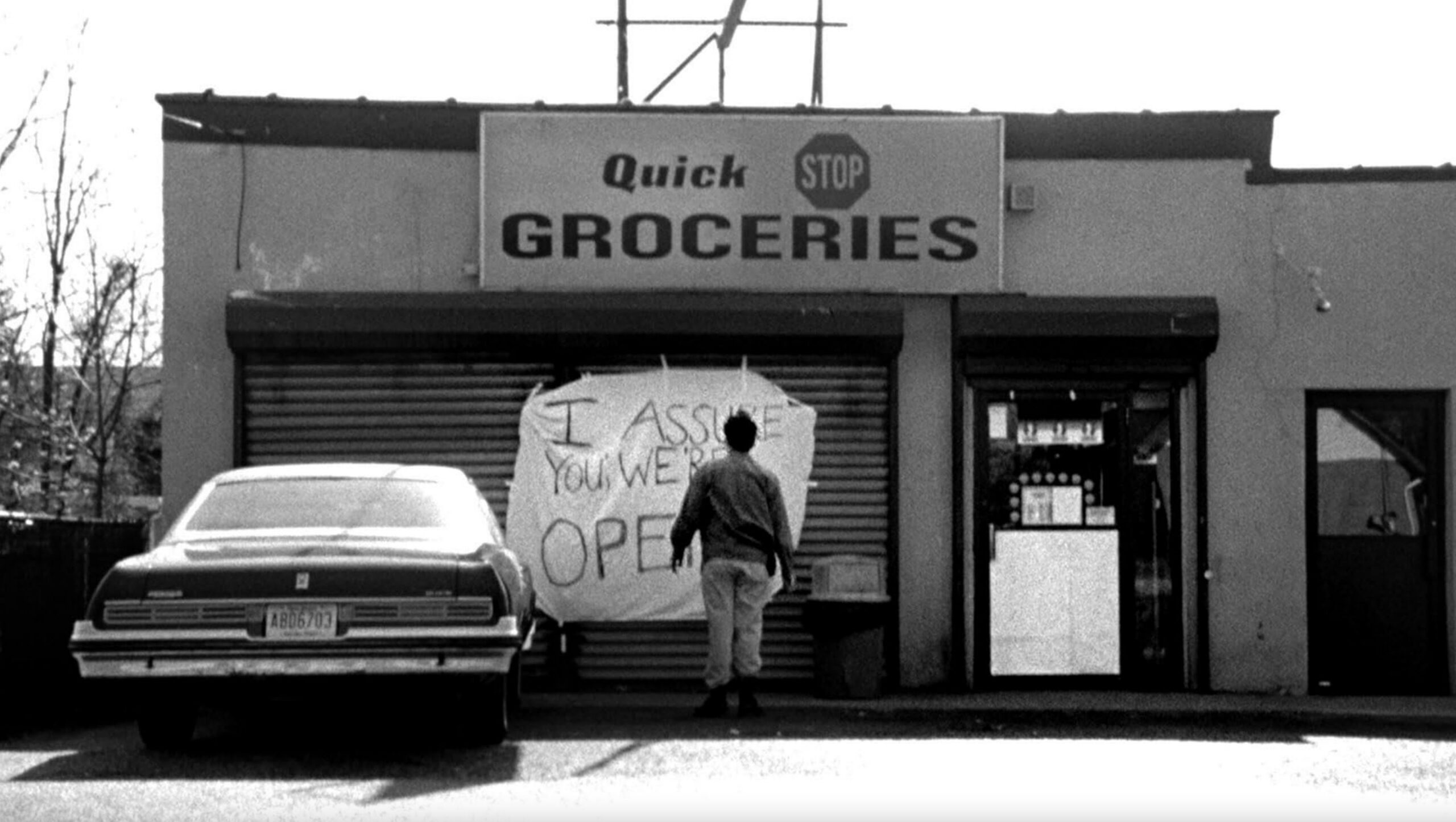
Film still from Clerks (1994). Image source IMBD
Christian Keathley is an independent film and video artist in Iowa City.
References
| ↑1 | Alexandre Astruc, “The birth of a new avant-garde: La camera-stylo,” in The New Wave, ed. Peter Graham (London: Secker & Warburg, 1968), pp. 17-23. |
|---|---|
| ↑2 | Andre Bazin, “An Aesthetic of Reality,” in What Is Cinema?, Volume II, ed. and trans. Hugh Gray (Berkeley: University of California Press, 1970), p. 32. |
| ↑3 | Bazin, “In Defense of Rossellini,” in What Is Cinema?, Volume II, p. 101. |
| ↑4 | Jacques Rivette, “Letter on Rossellini,” in Cahiers du Cinema: The 1950s, ed. Jim Hillier (Cam- bridge, Mass: Harvard University Press, 1985), p. 195. |
| ↑5 | Jacques Aumont, “The Variable Eye, or The Mobilization of the Gaze,” in The Image in Dispute, ed. Dudley Andrew (Austin: University of Texas Press, 1997), p. 232.
|
| ↑6 | Roland Barthes, Camera Lucida, trans. Richard Howard (New York: Hill and Wang, 1981). |
| ↑7 | Barthes, The Pleasure of the Text, trans. Richard Miller (New York: Hill and Wang, 1975). pp. 53- 54. |