Chasing Reality
Nan Goldin, Nan and Brian in Bed, New York City, 1981, Installation view, Photograph by Martin Seck, June 11, 2016–April 16, 2017. IN2354.30. Image Courtesy of The Museum of Modern Art, New York.
This version has been cropped
Share:
This text initially appeared in ART PAPERS September / October 1998 Vol. 22.05




Film history orbits around a potent anecdote. In 1872, photographer Eadweard Muybridge settled a $25,000 bet between a millionaire and another man, the millionaire believing that at some point during a gallop, his horse, Occident, would have all four feet airborne. Muybridge’s isolation of the movement of the horse’s trot proved, in a photographic sequence of images predating the motion picture, that the millionaire’s contention was true. Muybridge’s experiment affirmed that the physical world could be recorded and projected back to us in a way more real and accurate than what even the naked eye could discern-and that the camera is more perceptive than the eye itself. Ever since, film and photography have symbolized a trust in both as purveyors of concrete evidence and tangible truths.
This idea of film as truth is the basis of a new phase of documentary film and recent documentary photography, in which the act of photographing arrests and distills information we could not otherwise see. This newer belief in documentary’s power to distill the ephemeral qualities of our world runs counter to the historical tradition of “straight” or verité documentary’s clinical evisceration of raw fact.

Eadweard Muybridge, Photographic experimentation of animals in motion, 1877
While the visual arts have traditionally favored a more free-floating “eye of the beholder” approach, documentary film has historically embraced the social crusade or anthropological pursuit—a window on physically and psychologically distant lands seen in Robert Flaherty’s ethnographic documentaries (Nanook of the North, 1922; Tabu, 1931; Man of Aran, 1934), Frederick Wiseman’s revelation of barbaric conditions in mental institutions (The Titicut Follies, 1967), or Barbara Kopple’s examination of labor disputes in coal mining country (Harlan County, U.S.A., 1977). As Lewis Jacobs notes in The Documentary Tradition, “The documentary film came to be identifiable as a special kind of picture with a clear social purpose, dealing with real people and real events, as opposed to staged scenes of imaginary characters and fictional stories of the studio-made pictures.”3 Traditional documentarians—like the “direct cinema” pioneered by the Maysles brothers (Grey Gardens, 1976; Salesman, 1969; Gimme Shelter, 1970), Richard Leacock (Monterey Pop, 1969; Primary, 1960), D.A. Pennebaker (Don’t Look Back, 1967), and Wiseman (Law and Order, 1969; High School, 1969)—betray an allegiance to the photojournalistic perspective that was their original inspiration.
In revolutionary resistance to this high-art belief in the documentary as a vessel of journalistic enlightenment have been a cadre of personal filmmakers—Terry Zwigoff (Louie Bluie, 1985; Crumb, 1994), Michael Moore (Roger & Me, 1989; Pets or Meat, 1992), Errol Morris (A Brief History of Time, 1992; Fast, Cheap and Out of Control, 1997), Ross McElwee (Sherman’s March: An Improbable Search for Love, 1986; Time Indefinite, 1993), Ruth Leitman (Alma, 1998), Nick Broomfield (Aileen Wuornos: The Selling of a Serial Killer, 1992; Heidi Fleiss: Hollywood Madam, 1995; Fetishes, 1997; Kurt & Courtney, 1998), Joe Berlinger and Bruce Sinofsky (My Brother’s Keeper, 1995; Paradise Lost, 1996), Martin Bell (Streetwise, 1984), Steve James (Hoop Dreams, 1994), and Jennie Livingston (Paris Is Burning, 1990)—who valorize subjectivity, both their own and their films’, in a democratic refusal to assume the usual filmic approach of detached, journalistic appraisal. In assuming this immersion perspective, they invite our own immersion and a shared emotional investment in their material. Furthermore, they challenge the ostensibly neutral perspective of film, admitting their own collusion in reality’s manufacture. Paying homage to Muybridge’s notion that film can transmit truth, they also demonstrate a healthy skepticism in their acknowledgment that documentaries are, in essence, movies—not reality itself.
What has also emerged is a body of new documentary photography exemplified by the work of Jack Pierson, Mary Ellen Mark, Richard Billingham, Jim Goldberg, Paul Graham, Gillian Wearing, Nan Goldin, Sally Mann, Adrienne Salinger, Larry Sultan, Nobuyoshi Araki, Larry Clark, Rineke Dijstra, Wendy Ewald, and Philip Lorca-diCorcia. This new mode of documentary utilizes an emotional investment in their subjects to move beyond mere recording of the truth, for a participation in its making which gives these works an aura of emotional integrity.

Sally Mann, The Ditch, 1987, The Art Institute of Chicago, Gift of Sally Mann and Edwynn Houk Gallery

Richard Billingham, Untitled (RAL 2), 1993
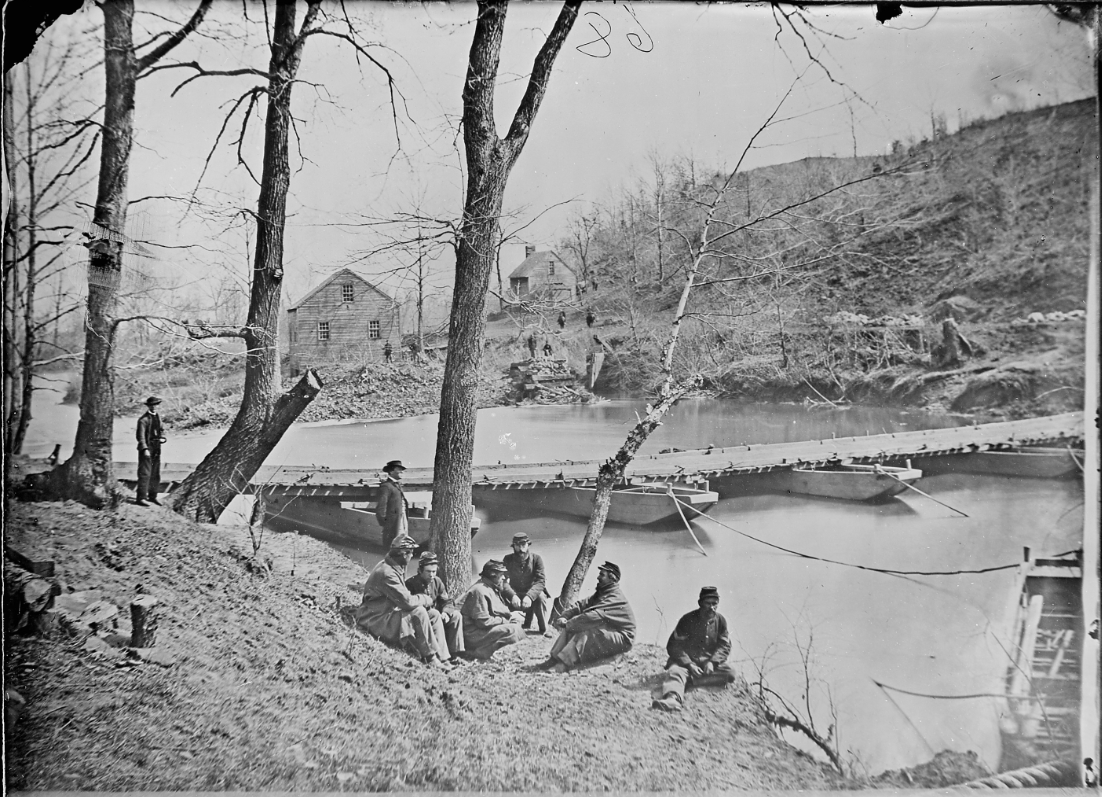
Matthew Brady, Image of Blackburn’s Ford, Virginia, c. 1863
As much as the act of photographing has traditionally been seen as emotionally detached, these filmmakers and photographers also suggest the potential for connection by a participation in the subcultures they document. Closer to snapshots and family photos than documents, these works also contain the pathos and disquiet of too-much-connection associated with these intimate forms, offering a sentiment-infused narrative of their friends and family’s lives and the estrangement or suffocation snapshots can depict. “Mostly what we recognize as emotion in them,” Hilton Als explains of Goldin’s work, is “a decisive emotional moment made evident.”4
Unmediated by wordy explanations or agenda, the snapshot is the ideal metaphor for those filmmakers and photographers who acknowledge the limitations of traditionally detached or fraudulently “connected” storytelling. Snapshots can often feel like the most titillating glimpse of the affectations and raw truth of people’s idiosyncratic reality; a pornography of private lives.
What all of this suggests is the ability of film to convey an emotional reality unfettered to any one set of conventions and a shared belief in the least measurable, metamorphic qualities of the person being photographed what has been described as their “essence” and a consequentially transcendent, democratic approach in such work. Like the spontaneous snapshot, or the paparazzi photograph, these images throw into harsh relief the borderline between the exterior, public self and the interior, private self.
Such recent documentary work illustrates the split branch of documentary photography, between work which conveys some intangible sense of the inner life of its subjects and work which merely documents a set of physical circumstances, often with the imposition of the photographer’s mission onto his or her subject matter. Walker Evans’ WPA work exemplifies this latter approach in his use of the human face as an iconic piece of American architecture not unlike the Victorian cupolas and picket fences of his other work.
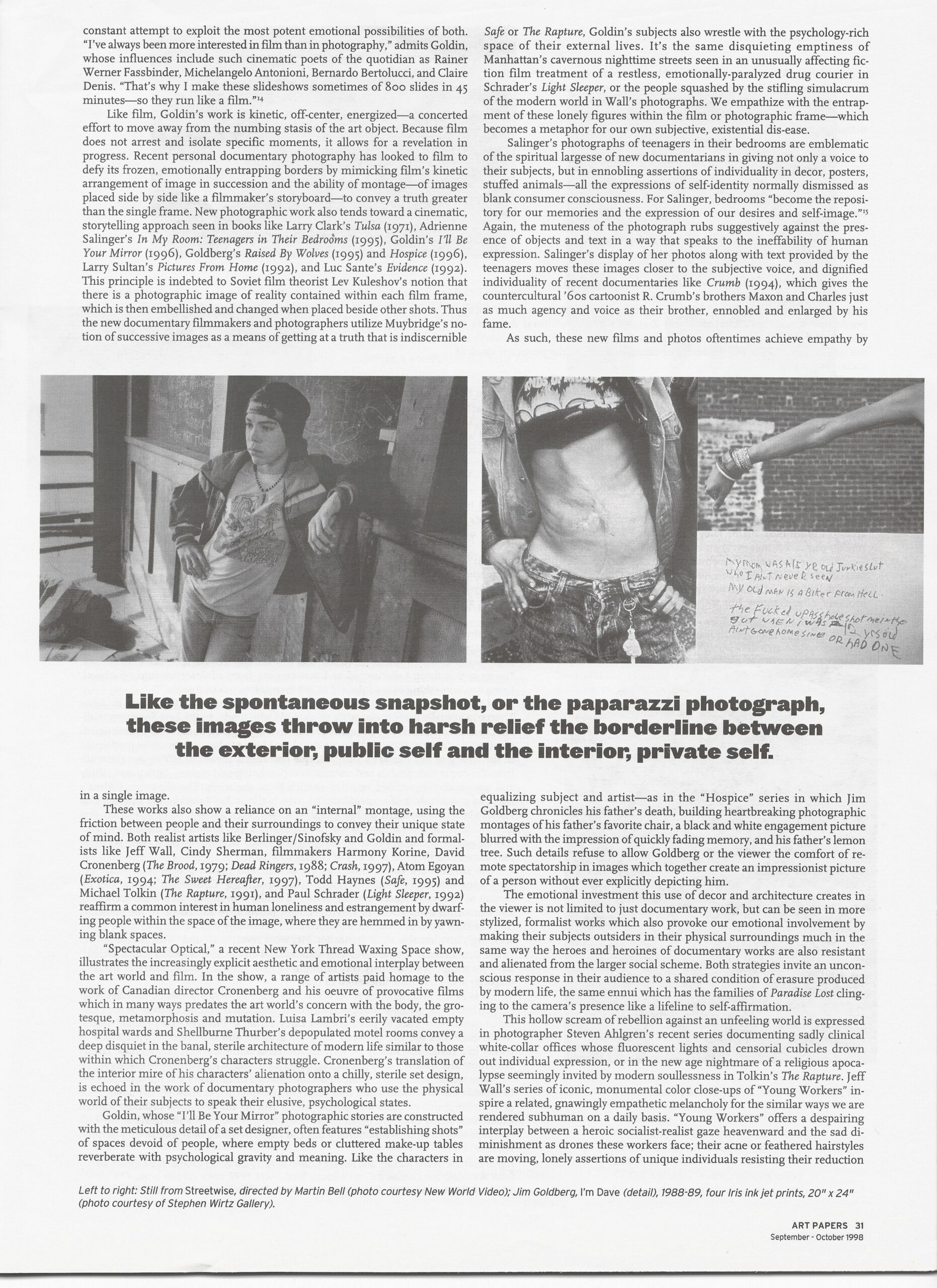
Bucking this aloof tradition of high-art portraiture have been photographers like Weegee, Diane Arbus, Civil War photographer Mathew Brady, E.J. Bellocq, Jacob Riis or William Eggleston. These photographers, not necessarily over entire careers but often in fleeting moments, presage contemporary trends by somehow tapping into the hidden structures of American life. Focusing on marginalized people or taking a casual, snapshot approach to their subjects, these emotionally evocative photographers allow for subtexts and themes to emerge outside of the photographer’s willful insertion of his or her own agenda.
Of his “Raised By Wolves” series of photos of homeless teenagers with text provided by them, Jim Goldberg notes, “the more I was on the street with the kids, what they were saying the big stories-was good. But the little stuff-the little vignettes-added up to something else.”5 What Goldberg’s work admits, like all of these new documentarians, is that the truth is not the unmasking of some corrupt institution, but the revelation of ordinary life “the little stuff” that sheds light upon our own lives.
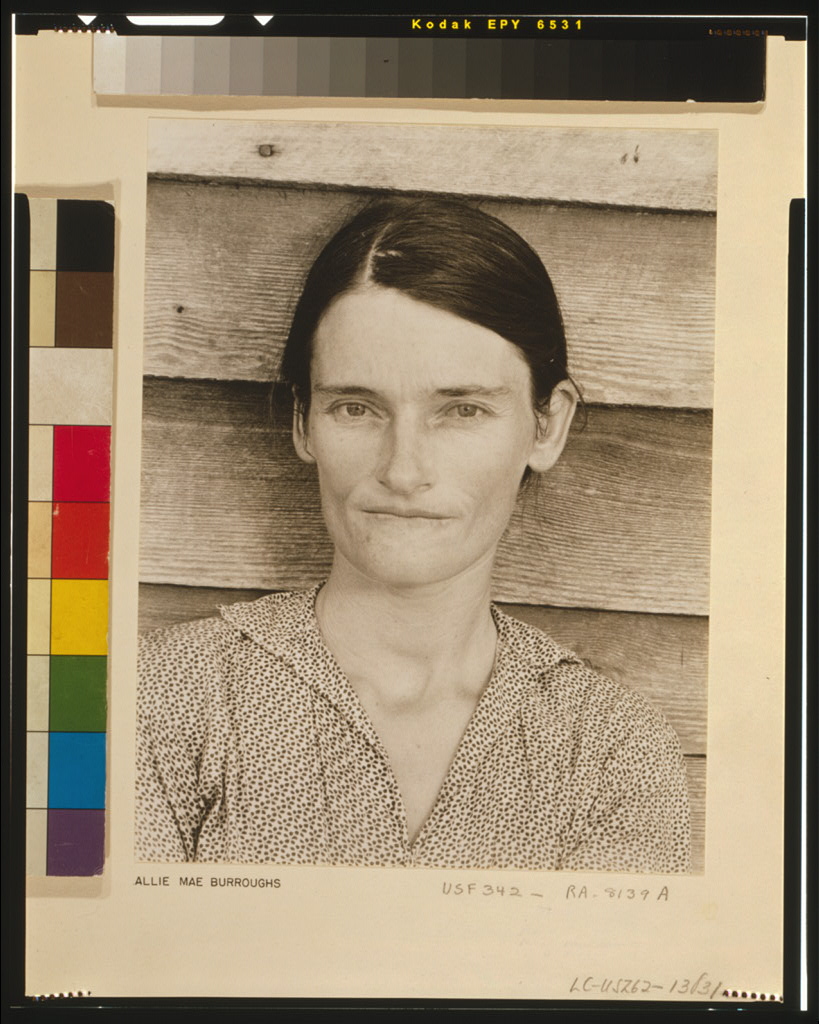
Walker Evans, Allie Mae Burroughs, c.1935. Photo: The Library of Congress

,
Though Muybridge proved the ability of film to arrest tangible realities, recent photographers and filmmakers contend with the quixotic task of relaying emotional, ethereal ones. What all of them counter is the pomposity of verité photography in claiming to unveil some ultimate kernel of truth with its self-consciously “objective” hand-held camera, wavering focus, or location sound. Informed by theoretical notions of truth as a subjective construct, and by larger social and cultural movements like the ’60s New Journalism pioneered by Tom Wolfe and Hunter S. Thompson, academic theory which stresses the death of the author and the nonlinear open-endness of European art cinema, these filmmakers admit to truth’s shape-shifting nature and the reality of what Goldberg stresses, that “nobody really knows what the truth is.”6
Those who consistently challenge conventionalized notions of realism to arrive at a more raw, stripped down emotional reality are those who strive, not for truth, but instead allow for the accidental gesture, the slippage of the masks of social decorum and self-definition, and allow the human face its expressive potential—what Artsmedia Editor Mary Behrens identifies in photographer Jack Pierson’s work as “the inability and failure of language to get across that which is, to one degree or another, inexpressible.”7
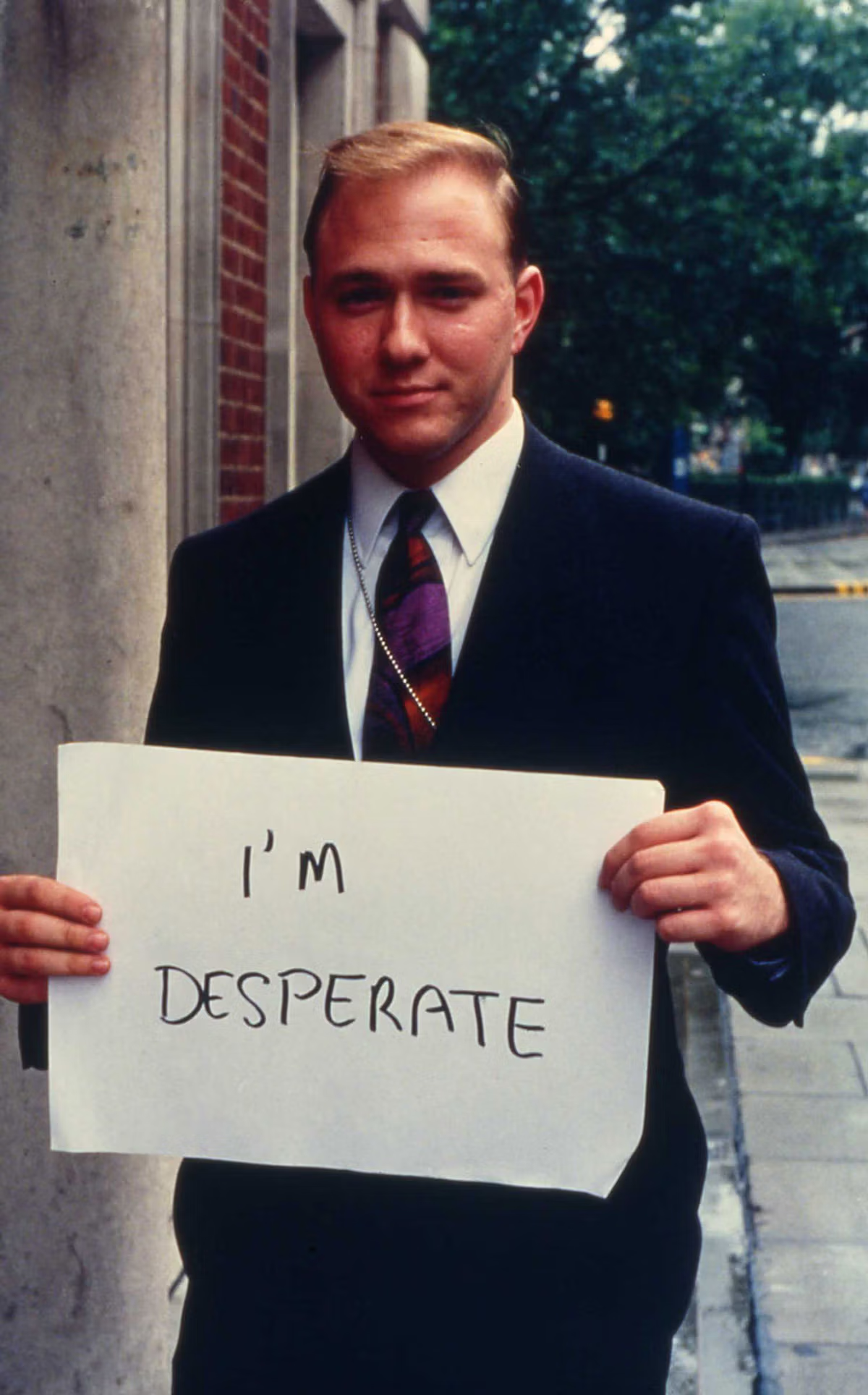
Gillian Wearing, ‘I’m desperate,’ 1992–3, © Gillian Wearing, courtesy Maureen Paley/ Interim Art, London. Photo: Tate, London 2026
This tendency to replace some metaphorical truth, or over-weening agenda symbolized within the photograph’s frame, with a more humanistic attention to ordinary lives, can be seen in British videographer/photographer Gillian Wearing’s deeply felt, evocative work. Suggesting the feminist mantra that “the personal is political” though devoid of any such overarching agenda, Wearing’s “Signs of the Times” photographs asked random British pedestrians to write a statement on a piece of paper which expresses their frame of mind in a characteristic expression of the new documentarian urge to penetrate the scrim of public life which obscures identity. Critic Ian MacMillan describes how much more potent and human this approach is than the empty diatribes of formulaic agendas. “Unlike the heavy-handed social documentary art of the 1970s with which it shared a reasonable affinity, …Wearing had managed to say far more about present-day life and its political dogma, the experiences of a whole spectrum of society, than a whole generation of theoretical and academic conceptualists.”8 Like filmmaker Errol Morris, who asserts that “people reveal themselves through the way they talk,”9 Wearing’s is a mission to capture the signs of identity and the essence of socially circumscribed truths flickering beneath life’s surface.
Recent documentary film and photography has traded overt social issues for a larger examination of universal experiences. Many are plotless, or use the mechanics of plot as a mere ordering device—the case in Paradise Lost—for broader examinations of the culture. With no ultimate message that the viewer can fondle for reassurance, these works mirror our similarly nonlinear lives, enlarging one’s sense of a common human experience. What the makers share is a trust in the truths which are beyond their control and in the ability of truth to be revealed, not by the magical apparatus of the camera-arresting life into successive images like Muybridge’s horse—but to show how reality exists in arrangement and context between and outside the margins.
The features which unite these new documentarians are an over investment in their material, a reliance on montage and the interrelationship between shots to tell a story beyond the image’s frame. Both of these groups of photography and filmmaking rely on the physical worlds of their subjects—their bedrooms, front porches and furnishings—to convey as much detail as their verbal testimonies. Many of these artists also share an interest in enlarging the agency of their subjects, giving them an involvement in their own image-making typified by Goldberg and Adrienne Salinger, who allow their participants to add diaristic text to their photographs. Most have an emotional connection to their subjects which makes their documenting of their lives in part an examination of themselves.
23-year-old Harmony Korine’s Gummo (1997) draws much of its inspiration from documentaries like Streetwise and Paradise Lost. Though his portrait of the depressing smalltown of Xenia, Ohio is fictional, his reliance on improvisation and his open-ended, apolitical storytelling link his work to the naturalistic grittiness of John Cassavetes or Goldin, or his mentor Larry Clark (for whom Korine wrote the Kids script). Gummo also offers the kind of nasty truthfulness reminiscent of the esoteric, personal documentary work of British photographer Richard Billingham’s images of his alcoholic, ruined family members. Korine’s population of the film with friends from his own Nashville hometown, ex-cons, paint huffers, the disabled and small children lends a further verité element which grounds Gummo in a personal documentary tradition in keeping with the biographical photography of Clark, Billingham, Goldin, and Arbus.
In his lawless world of throwaway children, Korine shows how every perversion, such as the boy who pimps his retarded sister to his pals, is relativized by environment. With no standards to measure sociopathy next to—and where adults are drunkards, rapists, pornographers, jailbirds, or mad—these kids become, by process of elimination, the prophets and heroes. In Gummo’s wirecrossed circuitry of powerlines, child molesters, cancer and Down’s Syndrome, Korine weaves a realist fairy tale of a poisoned world eating up its inhabitants from the guts out.

Film still from Harmony Korine’s Gummo* (1997) – This caption has been edited
In many ways, such recent work is the realization of Soviet film theoretician and filmmaker Dziga Vertov’s imperative that, “Truth was to be achieved by a direct encounter with uncontrollable life where the camera—in a figurative sense—set out to discover the genuineness of a particular human scene.”10 Part of that lack of control comes in allowing stories to ferment or decay naturally. Nick Broomfield’s Aileen Wuornos: The Selling of a Serial Killer is a case in point—a rambling fugue on the downtrodden prostitute-turned-accused Florida serial killer which becomes, like all of Broomfield’s films, a harsh indictment of a larger world far nastier than its representative sociopaths. Selling is a sickening re-appraisal of the documentarian’s agenda-based riddle “Why?” for the new documentarian’s counter “Why not?” Considering how corrupt and vicious the world Broomfield depicts is, populated with egomaniacal lawyers and sadistic johns, why wouldn’t Aileen Wuornos turn a knife on them?
In the same manner, the brutal crime documentary Paradise Lost, about three Arkansas teenagers accused of murdering three little boys in a satanic ritual, becomes a portrait of a morally diseased and dissolute community. For directors Joe Berlinger and Bruce Sinofsky, “The trial is really just the skeleton we hang everything else on…an ‘excuse’ for us to explore this town and what it went through, and to provide a portrait of these people.”11 The foamy bloodlust and thirst for vengeance expressed by the victims’ parents, the apathy of the killers, and the mania of displaced people anxious for the momentary acknowledgement of the TV camera makes Paradise Lost a nightmarish chronicle of a contemporary dystopia. Revelation comes—not in the mechanics of the criminal investigation and its unfolding—but in the sideways, inconsequential, seemingly banal moments which photographer Jim Goldberg also identified in his own portraits of homeless teens.
But the high priest of direct cinema, Albert Maysles—who innovated the use of hand-held cameras, objective reportage, and the fly-on-the-wall perspective of early documentary—recently told Paper magazine in a tirade against the recent subjective, morally ambivalent documentary, “The problem with most documentarians today is they’ve lost the ability to discriminate between what’s true and what’s false. This blurring of the line between fact and fiction, it’s so cynical.”12
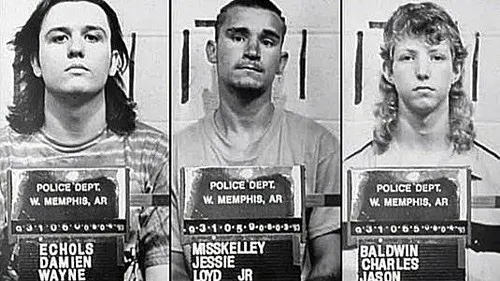
Composite of the mugshots of the ‘West Memphis Three,’ whose trial was the subject of the 1996 documentary “Paradise Lost.” Photo: Talk Business & Politics
The notion that reality can be parceled out into truth and fiction which traditional documentarians like Maysles proffer is a naive one which recent filmmakers counter, seeing the layered, shifting nature of the truth as their muse. Rather than presuming their films capture reality, they allow fragments of the real to emerge as a consequence of the act of photographing. In a world of constructed identity, social masquerades and denials, revelation of the truth is not contained in a word, but in a fleeting, vaporous gesture.
Errol Morris, advocate of a far looser, often humor-infused treatment of such ephemera as a pet cemetery in Gates of Heaven (1978), the carnivalesque backwater town of Vernon, Florida (1981) and, most recently, the spiritual connections between a lion tamer, engineer, rodent fetishist and topiary gardener in Fast, Cheap and Out of Control bluntly counters Maysles traditionalism. “My beef [is] with the metaphysical claims of verité, that it somehow has a greater degree of journalistic integrity” says Morris, “that it’s a more honest, trustworthy and faithful replication of reality. As truth it’s total nonsense, and filmmakers came to believe that bullshit.”13 This expression of Morris’s rebellion has been summarily punished by the documentary “establishment” by withholding Academy Award nominations for his celebrated work (such as The Thin Blue Line, 1988), a significant snub also delivered to Roger Moore (Roger & Me), Terry Zwigoff (Crumb) and Steve James (Hoop Dreams).
What recent film and photography work conveys is a recognition that truth lies not in technique, but in unplannable accidents and sudden disclosures which resist the ordering device of the camera. What both suggest is that truth is something residing outside the borders of an image; that our emotional connection is inspired as much by what we cannot see as what we can.
Goldin’s “The Ballad of Sexual Dependency” series is the effort which best exemplifies the mutually influential strengths of film and photography, and the constant attempt to exploit the most potent emotional possibilities of both. “I’ve always been more interested in film than in photography,” admits Goldin, whose influences include such cinematic poets of the quotidian as Rainer Werner Fassbinder, Michelangelo Antonioni, Bernardo Bertolucci, and Claire Denis. “That’s why I make these slideshows sometimes of 800 slides in 45 minutes so they run like a film.”14
Like film, Goldin’s work is kinetic, off-center, energized—a concerted effort to move away from the numbing stasis of the art object. Because film does not arrest and isolate specific moments, it allows for a revelation in progress. Recent personal documentary photography has looked to film to defy its frozen, emotionally entrapping borders by mimicking film’s kinetic arrangement of image in succession and the ability of montage—of images placed side by side like a filmmaker’s storyboard—to convey a truth greater than the single frame. New photographic work also tends toward a cinematic, storytelling approach seen in books like Larry Clark’s Tulsa (1971), Adrienne Salinger’s In My Room: Teenagers in Their Bedrooms (1995), Goldin’s I’ll Be Your Mirror (1996), Goldberg’s Raised By Wolves (1995) and Hospice (1996), Larry Sultan’s Pictures From Home (1992), and Luc Sante’s Evidence (1992). This principle is indebted to Soviet film theorist Lev Kuleshov’s notion that there is a photographic image of reality contained within each film frame, which is then embellished and changed when placed beside other shots. Thus the new documentary filmmakers and photographers utilize Muybridge’s notion of successive images as a means of getting at a truth that is indiscernible in a single image.
These works also show a reliance on an “internal” montage, using the friction between people and their surroundings to convey their unique state of mind. Both realist artists like Berlinger/Sinofsky and Goldin and formalists like Jeff Wall, Cindy Sherman, filmmakers Harmony Korine, David Cronenberg (The Brood, 1979; Dead Ringers, 1988; Crash, 1997), Atom Egoyan (Exotica, 1994; The Sweet Hereafter, 1997), Todd Haynes (Safe, 1995) and Michael Tolkin (The Rapture, 1991), and Paul Schrader (Light Sleeper, 1992) reaffirm a common interest in human loneliness and estrangement by dwarfing people within the space of the image, where they are hemmed in by yawning blank spaces.
“Spectacular Optical,” a recent New York Thread Waxing Space show, illustrates the increasingly explicit aesthetic and emotional interplay between the art world and film. In the show, a range of artists paid homage to the work of Canadian director Cronenberg and his oeuvre of provocative films which in many ways predates the art world’s concern with the body, the grotesque, metamorphosis and mutation. Luisa Lambri’s eerily vacated empty hospital wards and Shellburne Thurber’s depopulated motel rooms convey a deep disquiet in the banal, sterile architecture of modern life similar to those within which Cronenberg’s characters struggle. Cronenberg’s translation of the interior mire of his characters’ alienation onto a chilly, sterile set design, is echoed in the work of documentary photographers who use the physical world of their subjects to speak their elusive, psychological states.
Goldin, whose “I’ll Be Your Mirror” photographic stories are constructed with the meticulous detail of a set designer, often features “establishing shots” of spaces devoid of people, where empty beds or cluttered make-up tables reverberate with psychological gravity and meaning. Like the characters in Safe or The Rapture, Goldin’s subjects also wrestle with the psychology-rich space of their external lives. It’s the same disquieting emptiness of Manhattan’s cavernous nighttime streets seen in an unusually affecting fiction film treatment of a restless, emotionally-paralyzed drug courier in Schrader’s Light Sleeper, or the people squashed by the stifling simulacrum of the modern world in Wall’s photographs. We empathize with the entrapment of these lonely figures within the film or photographic frame—which becomes a metaphor for our own subjective, existential disease.
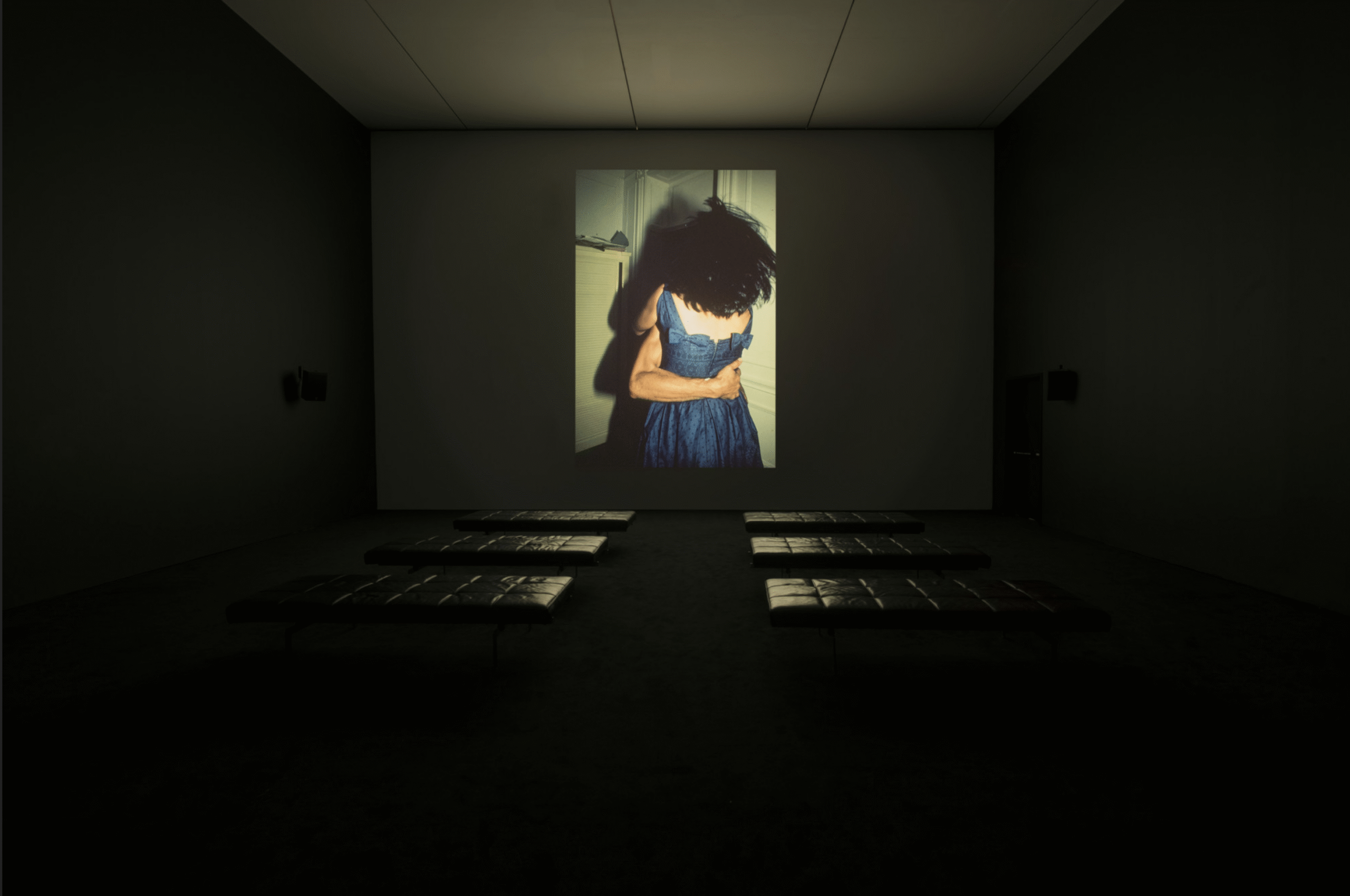
Nan Goldin, The Hug, New York City, 1980, Installation view, Photograph by Martin Seck, June 11, 2016–April 16, 2017. IN2354.29. Image courtesy of The Museum of Modern Art, New York.
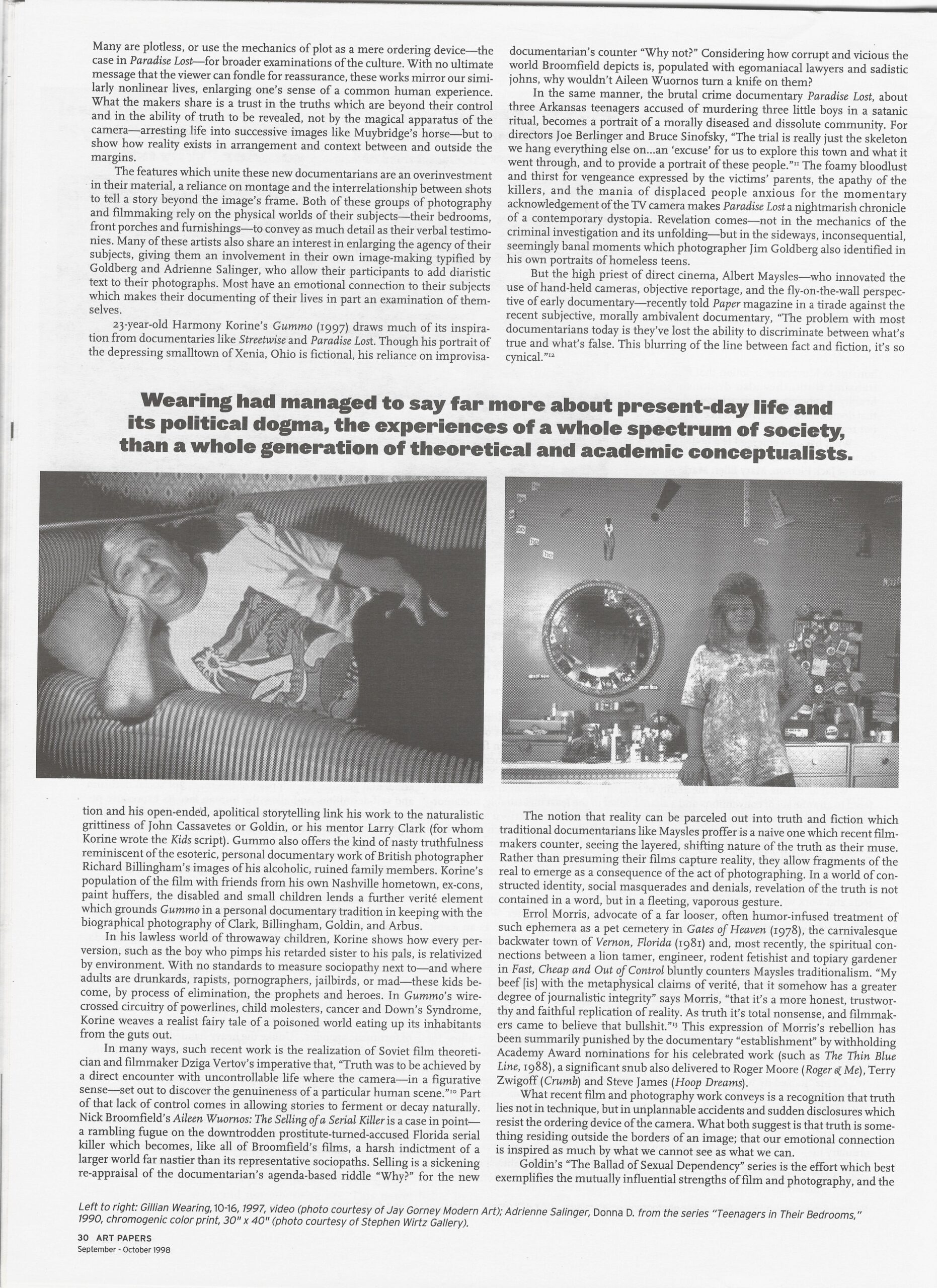
Salinger’s photographs of teenagers in their bedrooms are emblematic of the spiritual largesse of new documentarians in giving not only a voice to their subjects, but in ennobling assertions of individuality in decor, posters, stuffed animals—all the expressions of self-identity normally dismissed as blank consumer consciousness. For Salinger, bedrooms “become the repository for our memories and the expression of our desires and self-image.”15 Again, the muteness of the photograph rubs suggestively against the presence of objects and text in a way that speaks to the ineffability of human expression. Salinger’s display of her photos along with text provided by the teenagers moves these images closer to the subjective voice, and dignified individuality of recent documentaries like Crumb (1994), which gives the countercultural ’60s cartoonist R. Crumb’s brothers Maxon and Charles just as much agency and voice as their brother, ennobled and enlarged by his fame.
As such, these new films and photos oftentimes achieve empathy by equalizing subject and artist—as in the “Hospice” series in which Jim Goldberg chronicles his father’s death, building heartbreaking photographic montages of his father’s favorite chair, a black and white engagement picture blurred with the impression of quickly fading memory, and his father’s lemon tree. Such details refuse to allow Goldberg or the viewer the comfort of remote spectatorship in images which together create an impressionist picture of a person without ever explicitly depicting him.
The emotional investment this use of decor and architecture creates in the viewer is not limited to just documentary work, but can be seen in more stylized, formalist works which also provoke our emotional involvement by making their subjects outsiders in their physical surroundings much in the same way the heroes and heroines of documentary works are also resistant and alienated from the larger social scheme. Both strategies invite an unconscious response in their audience to a shared condition of erasure produced by modern life, the same ennui which has the families of Paradise Lost clinging to the camera’s presence like a lifeline to self-affirmation.
This hollow scream of rebellion against an unfeeling world is expressed in photographer Steven Ahlgren’s recent series documenting sadly clinical white-collar offices whose fluorescent lights and censorial cubicles drown out individual expression, or in the new age nightmare of a religious apocalypse seemingly invited by modern soullessness in Tolkin’s The Rapture. Jeff Wall’s series of iconic, monumental color close-ups of “Young Workers” inspire a related, gnawingly empathetic melancholy for the similar ways we are rendered subhuman on a daily basis. “Young Workers” offers a despairing interplay between a heroic socialist-realist gaze heavenward and the sad diminishment as drones these workers face; their acne or feathered hairstyles are moving, lonely assertions of unique individuals resisting their reduction to machinery. What many of Wall’s tableaux evocations of film stills convey is the creepy sense that the environments are merely sets, and the actions performed there only parodies of intimacy—in troubling commentary on our own emotionally vacuous, artificial existence.
British photographer Paul Graham evokes a comparable feeling of empathy in his politics-infused photographs of out-of-work British workers in the offices of relief agencies which tend to engulf the men and women in cavernous, bureaucratic space like Wall’s tiny people. Graham’s images capture, in moments of sublime revelation, the space where in-human, bureaucratic function collides with the dispirited, exhausted slipping of public masks in powerful commentaries on the human element squashed by institutions.
What these stylized and realistic environs show, either literally or figuratively, is what critic Melissa E. Feldman detects in Wearing’s work: “subjects who seem to have difficulty coping with social norms.”16 Whether Clark’s teenagers, Mann’s anarchically borderline sexual/pre-sexual children, Zwigoff’s countercultural dropouts or Broomfield’s sexual subversives, all of these artists take on social groups who have not yet gained (the case with children) or consciously avoid, the protective cloak of social acceptance.

Sally Mann, Candy Cigarette (21/25), 1989 © Sally Mann. Image courtesy of the Whitney Museum of American Art
What the majority of these artists share is a solicitation of connection and an interest in marginalized people who reflect back to us and give a gravity to the common human experience of isolation, estrangement, and loneliness. Broomfield’s seminal documentary Streetwise (1984), about Seattle runaways, is a nonlinear, anecdotal montage of the teenagers’ testimony of abandonment and displacement and a new social structure which sees children as an easily sacrificed impediment to a smoothly ordered home life. The testimony of the children, of their parents, and impressionistic shots of their street milieu make visible what society struggles to deny. Like Paradise Lost’s documentarians Berlinger and Sinofsky, Broomfield’s gonzo documentary style aggressively provokes and blatantly pursues the penumbra of “characters” who surround their central story in an effort to unmask them. They manipulate events without foreseeing the outcome part of the invasively ambiguous format of new documentary.
No better example of the emotional strides documentary film has made in the past decades is Ruth Leitman’s Alma, which treats the same gothic family funhouse of mental illness and the relationship between a mother and daughter as the Maysles brothers’ Grey Gardens, but without the exploitive edge-lending a respect and sympathy for its subjects even amidst the most horrifying revelations. Leitman echoes other documentarians’ interest in penetrating the social masquerade—often most elaborately performed by women—in Alma. “I’m very intrigued by liars,” Leitman confesses. “Lying is this thing I discovered as I was coming from adolescence into adulthood. Lying was something that adults did to get themselves out of trouble.”17
Leitman in many ways found her definitive muse of contorted reality in Alma Thorpe, a sexually brazen, eccentric 56-year-old who tends, in the best Southern tradition, to embellish and varnish reality to suit her purposes. In an effort to uncover such evasions, Leitman encouraged Alma’s daughter Margie to become an active participant in the telling of her mother’s story. Margie becomes a means of sifting out the truth from the coquettish denials and unconscious psychological tangles—both purposefully and unconsciously avoided realities—which cloak the truth. The slippage of Alma’s mask of coquettish, self-centered denial, which allows her to evade the damage that sexual abuse has wreaked on her daughter’s life, is the same kind of revelation that fiction-filmmaker Atom Egoyan has treated in films like Exotica and Calendar—”This idea of people acting out roles or creating situations where they twist their behavior into something they use as a way of coping with pain.”18
No single work better illustrates the denials and masks people take refuge behind―and these artists strive to reveal—than Wearing’s “Confession” series. Her insertion of children’s voices into the bodies of adults who mouth their heartwrenching and humorous confessions is a transcendent, provocative admission of the invisible, unrecordable truth of a fragile, wounded child sensibility lurking deep within a gruff, seemingly invulnerable adult demeanor. Her work revolves around “what people project as the human mask they are—as they walk around on the streets and in public places.” Says Wearing, “It’s obviously very different to what goes on inside. There is always a disparity and I am quite interested in that.”19
It is in the process of close scrutiny, which the camera’s presence provides, that certain impacted realities come unhinged and begin to reveal themselves in the emotional catharsis typified by photographer Larry Sultan’s “Pictures From Home” series, which examines the gap between the photographer and his father’s conceptions of reality in a revisionist family portrait composed of home movies, mementoes, family snapshots and Sultan’s own photographic revisitations of his family’s mythology.
The recent trend most visible in documentarian filmmakers and photographers is to explode the flat surfaces and cool theory of post-pop art, to allow for the emergence of something more fragile and poetic, which affirms the texture of ordinary human experience. Many express a belief in the body, the grotesque, sex and death as the hidden repositories of such emotional truth and the extremities of response they inspire.
Significantly, the desire for revelation of hidden realities as a conduit to the urge for connection can be seen not only in the works of these filmmakers and photographers, but in curatorial revisitations of historical documents, from Stanley Burns’ pioneering post-mortem photography collections to Norfleet’s Death Scenes: A Homicide Detective’s Scrap-book. Published in 1973, was a representative progenitor of this revisionist look at the past-a fortuitous montage of period photos and newspaper articles of a small Wisconsin town that strives to convey the essence of a time and place, the ghostly penumbra of the truth lingering on documents. Work like Lesy’s illustrate the power of even the most objective and remote document-like the evidence photo-to unconsciously evoke the rawest substance of another life, an effort attempted in a popular vein in Ken Burns’ Civil War-gothic PBS series.
As with Goldberg’s “Hospice,” artists admit, with photographic evidence, the ethereal impermanence which photographs ostensibly suspend-bringing us bodily into the reality of another being’s suffering. Rather than the cold, analytical gaze of a desensitized, unfeeling world sifting through history’s dustbin for some new outrage, this revisionism of taboo, layman photography expresses the opposite. It is the same drive seen in the emotional nakedness these other artists strive consciously for a desire for bodies, nakedness, blood, tissue, sentiment, pain and a physical reality which points to the delicate connective tissue of universal, timeless human experiences as opposed to the present stiflingly of-the-moment condition. There is often a kind of dialogue between these art objects and viewers which makes one conscious of one’s place in the world, of one’s corporeality and mortality. Sante’s Evidence, for instance, gives a transcendent God’s eye view of the final loneliness in death which reverberates across time. Filmmaker Schrader repeats this perspective of a sleeping John LeTour (played by Willem Dafoe) in Light Sleeper (and also in his script for Martin Scorsese’s Taxi Driver) to intensify the sense of sympathetic loneliness and a feeling of collusion in LeTour’s suffering, which we come to share. Echoing the eerily static mini-death of every photograph, these images of death and dying symbolically reiterate our own isolation. It’s the loneliness which seeps through in these images which can make them seem more “true” than any effect consciously strived for. What they elucidate is the reality that art captures and arrests our separateness—the feeling we are born alone and die alone.
What this interest in the morbid, the banal, the ordinary lives of people, the overly-embellished bedrooms of one’s id and the sparse living rooms of the ego conveys is the new documentary’s final interest in how to represent our own emotional suffering. By boldly acknowledging their own obsessions, by the poetic disclosure of other people’s most intimate realities, this new documentary aesthetic makes us conscious of the shared limitations and quiet grace of our own lives.

Nan Goldin, Nan and Brian in Bed, New York City, 1981, Installation view, Photograph by Martin Seck, June 11, 2016–April 16, 2017. IN2354.30. Image Courtesy of The Museum of Modern Art, New York.
Felicia Feaster is an independent art and film critic in Atlanta.
References
| ↑1 | Lewis Jacobs, The Documentary Tradition: From Nanook to Woodstock, Hopkinson and Blake (New York: 1971), p. 7. |
|---|---|
| ↑2 | Andrew Wilson, Gillian Wearing, Carol Squiers, Paul Graham (London: Phaidon Press, 1996), p.16. |
| ↑3 | Jacobs, p.2. |
| ↑4 | Hilton Als, “The Third Set: Hilton Als’ Salon de Difference: Nan Goldin and Dominique Nabokov,” Artforum (January 1994), p. 58. |
| ↑5 | http://www.sfmoma.org/EXHIB/WOLVES/interview.html. |
| ↑6 | Ibid. |
| ↑7 | http://www.capecodaccess.com/Gallery/Arts/arts97/pierson.html. |
| ↑8 | Ian MacMillan, “Signs of the Times,” Modern Painters (Autumn 1997), PP. 52-55. |
| ↑9 | Carlo McCormick,”Reality Bites,” Paper (May 1998), p.56. 10 |
| ↑10 | Jacobs, p.375. |
| ↑11 | http://www.gothamcity.com/paradiselost/interview.html |
| ↑12 | Paper, p. 55. |
| ↑13 | Paper, p. 56. |
| ↑14 | Interview with the author,. May 1998. |
| ↑15 |
Dulch Leimbach, “A Room of Their Own,” The New York Times Book Review, October 15, 1995. |
| ↑16 | Melissa E. Feldman, “Gillian Wearing,” Art in America (July 1997), p.102. |
| ↑17 | Interview with the author, March 1998. |
| ↑18 | Lawrence Chua, “Atom’s Id,” Artforum (March 1995), p. 26. |
| ↑19 | John Slyce, “Wearing a Mask,” Flash Art (March/April 1998), p. 91. |