
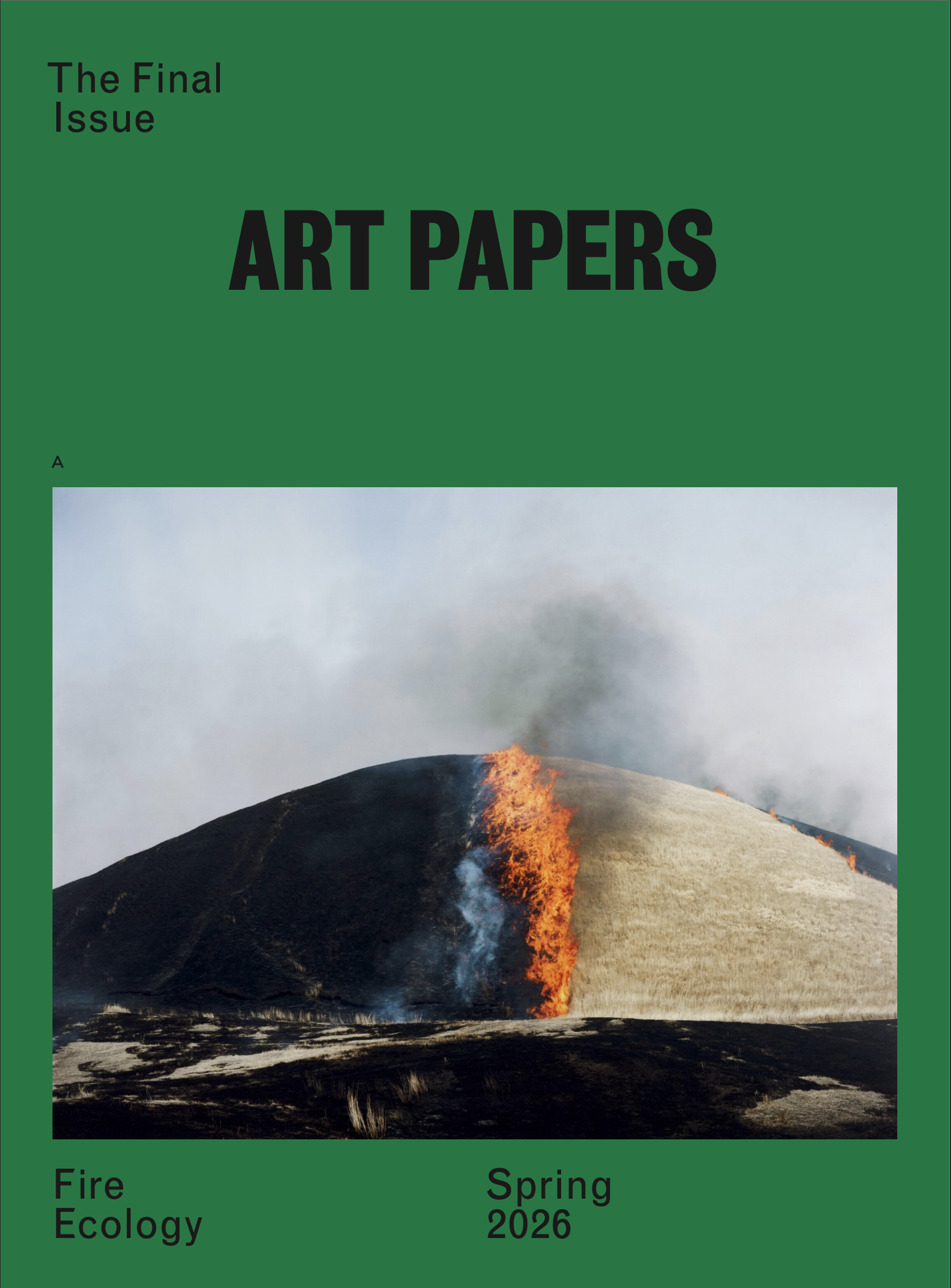
Rinko Kawauchi, Untitled, from the series Ametsuchi, 2013, [courtesy of the artist and Rose Gallery, Los Angeles]
Fire Ecology
Share:
Leaving a legacy isn’t optional. We’re doing it every single day.
—Alua Arthur, from her TED Talk “Why thinking about death helps you live a better life”
This special issue of ART PAPERS is the synthesis and culmination of a three-year project, initiated in response to fatal budget shortfalls, to extend the life of the organization for a period that would allow for a dignified end. The plan, inspired by Indigenous practices of ecological stewardship through intentional burning, took up the metaphor of Fire Ecology, the practice of maintaining ecosystem health by using fire to burn old growth, thereby fertilizing the soil and allowing new growth to thrive.
In 2025, Art Papers hosted two milestone programs: Atlanta Art Ecosystems—a series of public conversations that brought together members of Atlanta’s visual art community to tackle the urgent issues facing nonprofit arts organizations in our hometown—and a national Art Writing & Publishing Symposium, a three-day gathering that brought together voices from art writing, criticism, and contemporary art publishing to examine the field’s present and future.
Atlanta Art Ecosystems was built upon the belief that our community already has the ideas, innovative projects, and visionary leadership needed to forge a sustainable future for the visual arts in our city. Yet we also acknowledged many challenges that, when seen from within a community, might appear specific and isolating but are shared by others.
During the Art Writing & Publishing Symposium, one word kept coming up: nourishing. We—who typically focus our attention and acumen on the work of others as we seek to contribute meaning, support, criticality—were able to turn our gaze upon our own work, our craft, our community. And that felt nourishing. The Symposium convened more than 200 people from Atlanta, elsewhere in Georgia, New York, Baltimore, Birmingham, Chicago, Knoxville, Los Angeles, Miami, Milwaukee, New Orleans, Philadelphia, Washington, and even some international guests from London and Montreal. On the first day, I addressed the gathering to tell part of the Art Papers story and to offer a deep dive into conditions that led up to, and informed, the organization’s final chapter, which this issue documents. That talk, titled “Fire Ecology,” has been revised for print and included here in full.
Fire Ecology has been an experiment. This publication serves as documentation of that experiment, and its outcome. The true “final print issue” of ART PAPERS was 47.01, in Fall 2023—Counter Ecologies—guest edited by Carson Chan and staff of the Emilio Ambasz Institute for the Joint Study of the Built and Natural Environment at MoMA. That was the last regular print periodical we published before shifting to an online-only model, wherein we continued to publish the themed issues that were already funded by a grant from the National Endowment for the Arts. This publication is more accurately described as a bonus issue.

Rinko Kawauchi, Untitled, from the series Ametsuchi, 2013, [courtesy of the artist and Rose Gallery, Los Angeles]
On the cover and alongside this letter are selected photographs by Rinko Kawauchi that come from her Ametsuchi series. They depict yakihata—a traditional Japanese practice and philosophy of farming with the use of beneficial fire. Kawauchi’s poetic depictions evoke the fleeting nature of human existence within time frames far longer than a lifespan, far greater than memory.
ART PAPERS has a long tradition of publishing documentation and synthesis from conferences and convenings—particularly in the magazine’s first two decades. It feels fitting, then, that we return to that form for this special edition. This issue offers abridged versions of conversations from both convenings, “distilled” by Jaedon Clarke Mason into highlights that we hope capture the essence and tone of the dialogues.
For Atlanta Art Ecosystems, we opted to invite a houseguest to visit, and to close the program by sharing a case study. Fawz Kabra, Isak Berbic, and their son Nur Berbic were our guests, and they shared the story of Brief Histories. Their presentation has been adapted for inclusion here.
Be Oakley’s Genderfail publishing project—specifically their text “Failure as Futuremaking”—has been an inspiration in this work. I returned time after time to their questioning lines, “DO WE BECOME FAILURES IN ORDER TO PRESERVE A MEASURE OF AUTONOMY? OR DO WE EMBRACE SUCCESS TO LIVE?” Oakley’s work is represented here by a republished version of the “Failure as Futuremaking” text. Genderfail is also present throughout this issue in the use of one of the project’s protest fonts for titling, a typeface drawn from handmade protest signs—in this case, from the RISD Teamsters/New School Adjunct Strikes.
In “Tools for Carving Away—Mel Chin’s Revival Field & the Role of the Artist in Public Practice,” Heather Bird Harris returns to Chin’s iconic 1990 work to explore how it presents “a set of tools that artists can use to make long-term social impact possible, even within hostile systems.”
The work of Fire Ecology has been to end well—to bring the organization to a conclusion that secures our legacy, one that ties up our loose ends and leaves a gift of access to those who come looking for what Art Papers was. In “Death and the Afterlife,” our own Amy Miller offers a window into that process, and a view of where—and how—Art Papers can be found in the future.
“The Project of Ending” weaves together two separate but related conversations. Jordan Eddy met with me to discuss the end of Art Papers and with Tempestt Hazel to discuss how an ending can be prefigured in the values of an organization from its genesis—as in the case of Sixty Inches From Center, which Hazel cofounded. Accompanying these entwined dialogues is an artist project by James Perkins. The selected photographs follow Perkins through his practice, which references art historical traditions of land art and minimalism through performance and durational process. In this context, they resonate with the work of institution building as a world-building and site-embedded practice.
In the final entry to the long-running ART PAPERS glossary, Cannupa Hanska Luger thinks about Hyperstition (n.) as a way of marking how what we imagine becomes the world we inhabit.
The people brought together by the Fire Ecology project—its programs and publications—have contributed their stories and have shared their knowledge and their projects. These acts of generosity represent a forest of new growth.
When I joined Art Papers staff in 2018, I never imagined that the heart-heavy burden—and honor—of writing the final editor’s letter would fall to me. And yet, here we are, together, in grief, and in celebration of a magnificent half-century run. There are many people to thank, and much of that acknowledgment will take place in the forthcoming 50 YEARS of ART PAPERS retrospective book. But in the space of this issue, I must extend special thanks to Contributing Editors Re’al Christian and TK Smith, both of whom have been steadfast thought partners, advisors, and emotional supports when this work has felt like a wound. They, along with others in the extended Art Papers network, have reminded me that grief is love, and that mourning is an observance of devotion.
In the immortal words of Donna Summer:
So let’s dance, the last dance.
Let’s dance, the last dance.
Let’s dance, this last dance tonight