50 YEARS of ART PAPERS

Featuring the most timely, timeless, and ahead-of-their-time texts from five decades of independent, artist-centered, and artist-produced writing in ART PAPERS—the longest-running nonprofit art magazine in the US.
Share:
50 YEARS of ART PAPERS tells the story of 5 decades of independent, artist-centered, and often artist-produced publishing by tracing the work of the longest-running nonprofit art magazine in the US. Capturing the unique perspective of this publication—from its origins as the Atlanta Art Workers Coalition Newspaper to an internationally distributed, globally engaged publication—the book captures some of the most timely, timeless, and ahead-of-their time texts from the past half-century of art criticism. Taken together, these selections present a rare view of independent art criticism over 50 years as viewed, locally and globally, from Southern perspectives.
ART PAPERS marked its 50-year anniversary in 2026 by concluding operations and sunsetting the organization. 50 YEARS of ART PAPERS serves as a testimonial and artifact of the publication’s singular contribution to print and digital media—celebrating a legacy of bringing marginal views to the center.
Interspersed between the full-color archival selections are dialogues with past editors and designers who stewarded ART PAPERS’ singular voice in American art publishing, a foreword by co-founder Dan R. Talley, an introduction by Editors Sarah Higgins and Re’al Christian, and the complete ART PAPERS glossary—a long-running segment in which artists, critics, and scholars take up a term, or terms, relating to issue themes and present experimental definitions.
440 pages
edition of 500
9.45 x 11.8 inches
Designed by Jacob Lindgren
$75 USD + shipping
Order your copy of this limited-run book today!
Texts by: Robert Abbott, Jasmine Amussen, Paul Allen Anderson, Benny Andrews, Margaret Archuleta, Linda Armstrong, Edward Austin Hall, Isis Awad, Stephanie Bailey, Shumon Basar, Tal Beery, Barry Bergdoll, D. Eric Bookhardt, Jennifer Bonner, Crystal Britton, Alice Bucknell, Cathy Byrd, Victoria Camblin, Sue Canning, Re’al Christian, Christoph Chwatal, Gabriel Cira, Sasha Cordingley, Will Corwin, Benjamin Critton, Jerry Cullum, Martin G. Fuller, Roy Gary, Maria Gonzales, Cory Dugan, Sarah Higgins, Harris Dimitropoulos, Rebecca Dimling Cochran, Kimberly Drew, Ruth Dusseault, Keller Easterling, Patricia Eunji Kim, Harmony Hammond, David Everitt Howe, Barbara Hutsell, Julia Fenton, Chris Fite-Wassilak, EC Flamming, Daniel Fuller, Charlie Hailey, Craig Hall, Glenn Harper, Anthony Hawley, Jerron Herman, Heath Holmes, Gi (Ginny) Huo, Christopher Robert Jones, Kellie Jones, Christopher Joseph Lee, Jennie Klein, Raphael Koenig, Paul Krainak, Brandon Labelle, Shivanjani Lal, Lilly Lampe, Amy Landesberg, Nathan Lee, Elizabeth Lide, John Lindell, George C. Longfish, Courtney McClellan, Jillian McManemin, Richard Meyer, Ann Millet-Gallant, Gean Moreno, Humberto Moro, Hannah Palmer, Maxwell Paparella, Tom Patterson, Patricia Phagan, Susan Platt, Sascha Pohflepp, Risa Puleo, Dinah Ryan, Barbara Schreiber, Steve Seaberg, Maureen P. Sherlock, Gregory Sholette, Shirley Shor, Floria Sigismondi, Noah Simblist, Fanny Singer, Jennifer Smith, TK Smith, Alan Sondheim, Sue Spaid, Buzz Spector, Yvonne Stahr, Tyler Stallings, Sophie Strand, Dan R. Talley, Mildred Thompson, Christian Walker, Dominique White, Elvia Wilk, Tod Wodicka, Xenia Zed, and Drew Zeiba.
Writing on: Kathy Acker, Emma Amos, Keith Anger, Ida Applebroog, Iwan Baan, Radcliffe Bailey, Matthew Barney, Yael Bartana, Dara Birnbaum, Beverly Buchanan, Center for Tactical Magic, Wes Cochran, Vaginal Davis, Walter De Maria, Nicole Eisenman, Guillermo Gomez-Peña, Che Gossett, David Hammons, Derek Jarman, Katherine Jentleson, Mary Kelly, Johnathon Kelso, Mary Ellen Mark, Keith Antar Mason, Park McArthur, Richard Misrach, Kelly Taylor Mitchell, David Naugle, Alison Nguyen, Adrian Piper, Martin Puryear, Michael Rakowitz, Colin Renfrew, Faith Ringgold, Anderson Scott, Andres Serrano, Robert Smithson, Rural Studio, TABOO, Mario Garcia Torres, Marcia Tucker, Christian Walker, Carrie Mae Weems, Ge Yulu, and others.
Perhaps the most famous—or infamous—cover in the history of ART PAPERS was the January/February 1993 issue, which bore the image of a Xeroxed rooster. Inspired by Mildred Thompson’s dialogue with Guillermo Gomez-Peña and Keith Antar Mason, in which the artists discussed the significance of a dead chicken in a recent collaboration, the image served as the “cover image” for an issue that was, in actuality, coverless—a cost saving gesture.
The cover design for 50 YEARS of ART PAPERS draws inspiration from this iconic cover image, and from the scrappy, DIY, indomitable tenacity that ART PAPERS has embodied throughout our history.
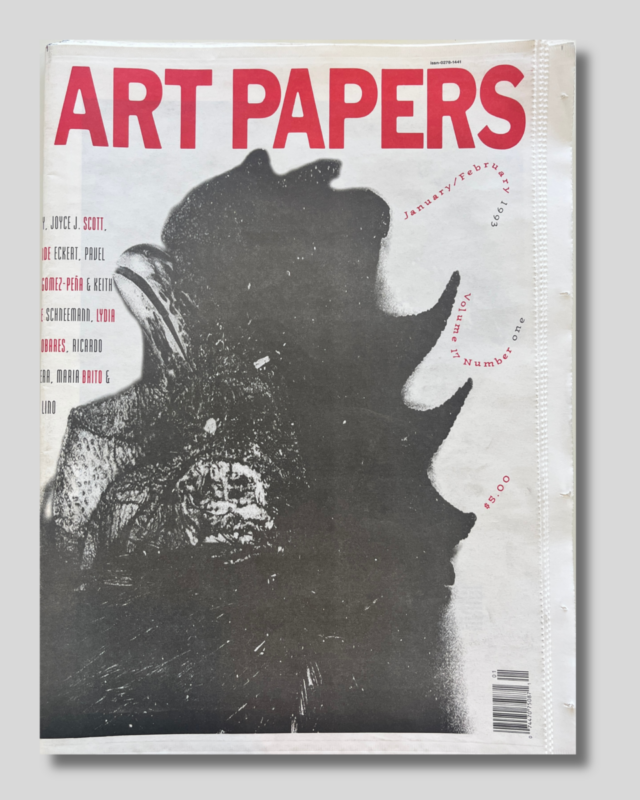
Cover of ART PAPERS Volume 17 Issue 1 from January/February 1993