Tools for Carving Away
Mel Chin, Revival Field MN, Thlaspi Specimen, 1993
Share:
I think the most important motivation as an artist is to use what James Baldwin has described as extracting the question that is buried within the answer. If the answer is, “The world will be inundated and destroyed by our own doings,” then what is the question that we have to ask now?1
—Mel Chin
In 1990, Mel Chin had an idea. After reading an article in the Whole Earth Review about the potential of the plant Datura to cure lead-contaminated soil, he began a feverish search for scientists working in the emerging field of phytoremediation.2 The pursuit led Chin to Rufus Chaney, a senior research agronomist at the USDA, whose research on hyper-accumulator plants had stalled during the first Bush administration due to lack of funding.
Chin recalls telling Chaney, “I have this idea, and you have this idea. Let me learn about the science behind it, and maybe we could work together, so we can do what you need.” Chaney replied that what he truly needed was funding for a replicated field test to make the science. Chin noted, “We had to make the artwork create the science.”3
The project survived multiple near failures. Funding was revoked. Bureaucratic permissions were denied. Still, in 1991, Revival Field launched as a replicated field test at Pig’s Eye Landfill, a Superfund site in St. Paul, MN. The use of Thlaspi, an edible herb also known as pennycress, effectively demonstrated the feasibility of green remediation, proving Chaney’s hypothesis and establishing a means to remediate cadmium- and zinc-contaminated soils—one still used today—and making a material difference in public health on a global scale.
Today, the work of many artists and scientists is again stalled due to a similarly dire, conservative funding landscape. A third of American museums lost federal funding after the National Endowment for the Arts abruptly terminated more than $27 million in grants last May. The trickle-down is affecting artists and arts workers as exhibition, residency, and grant opportunities evaporate. Meanwhile, Project 2025 advances a broader dismantling of social infrastructure and safety: mass detentions and deportations, diminished access to healthcare, suspended and permanently reduced food assistance. Hunger, sickness, and bone-tired survivalism are endangering ideas, too.
The question, then, is urgent: How can an idea still grow in harsh conditions?
Revival Field offers more than a celebrated precedent in social practice. It also offers a set of tools that artists can use to make long-term social impact possible, even within hostile systems. Revival Field’s enduring impact comes not only from its groundbreaking conceptual gesture, which has been written about extensively, but also from Chin’s soft skills and adaptive ability to embody the roles of visionary, political ecologist, connector, shapeshifter, and caretaker.
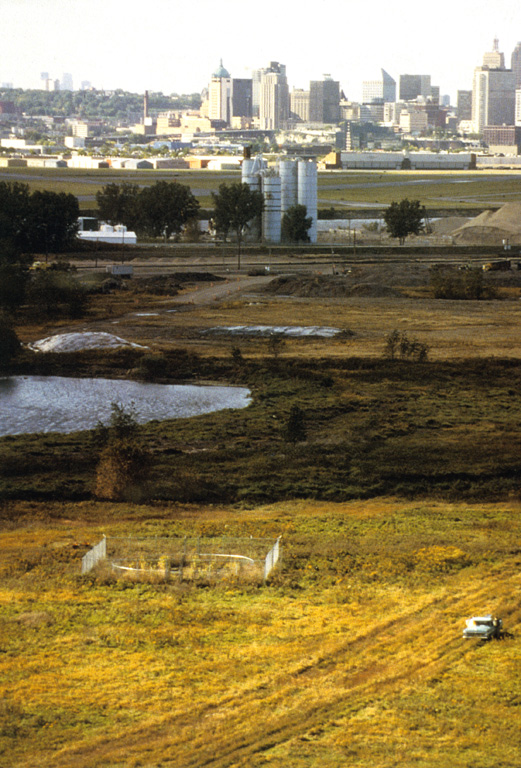
Mel Chin, Revival Field, 1991. Process image. [photo: David Schneider; courtesy of the artist]
Artist as Visionary
To realize Revival Field, Chin worked for nearly a year without income, borrowing money to stay afloat. On a recent afternoon at his studio compound in North Carolina, he recalled, “I was so broke, desperate. But it didn’t bother me. I said, ‘No, this is worth it, because this idea is worth it.’”
Life itself was at stake. If left in the soil, cadmium and zinc can leach into water systems, accumulate in the food chain, and cause a host of severe health issues in humans and fauna. Heavy-metal pollution is an invisible crisis of compounding harm to our soil—our foundational matter. Moved by the urgent and poetic potential of phytoremediation, Chin imagined the plants’ ability to extract poison from the soil as an “invisible aesthetic”4 in its truest ecological form: beauty as a beacon of health.
At the time, he was reading The Body in Pain by Elaine Scarry, which argues that physical suffering “unmakes” the world by removing human capacity for language. “The inverse of that is imagination,” Chin said, paraphrasing Scarry’s theory that artistic creation is an act of “making” the world again. “If we start imagining, something will occur in our mind that craves for a verb or something to drive it. It remakes language.” Revival Field, then, becomes an act of remaking.
From its earliest stages, Chin subjected the idea to relentless scrutiny. “I personally go through tremendous turmoil of self-critique,” he remarked, noting the importance of this process for anyone working in public practice. “You have to put the concept under fire … before going to the next step. Every step along the way.”
Once realized, Revival Field encountered many obstacles. Chin’s clarity of vision became crucial, as anything less clear might have allowed the idea to give way. Chin recounted advice from a white activist who had worked with the Freedom Riders: “Just be very, very clear about what your thing is about. Be solid in your commitment and conviction.”
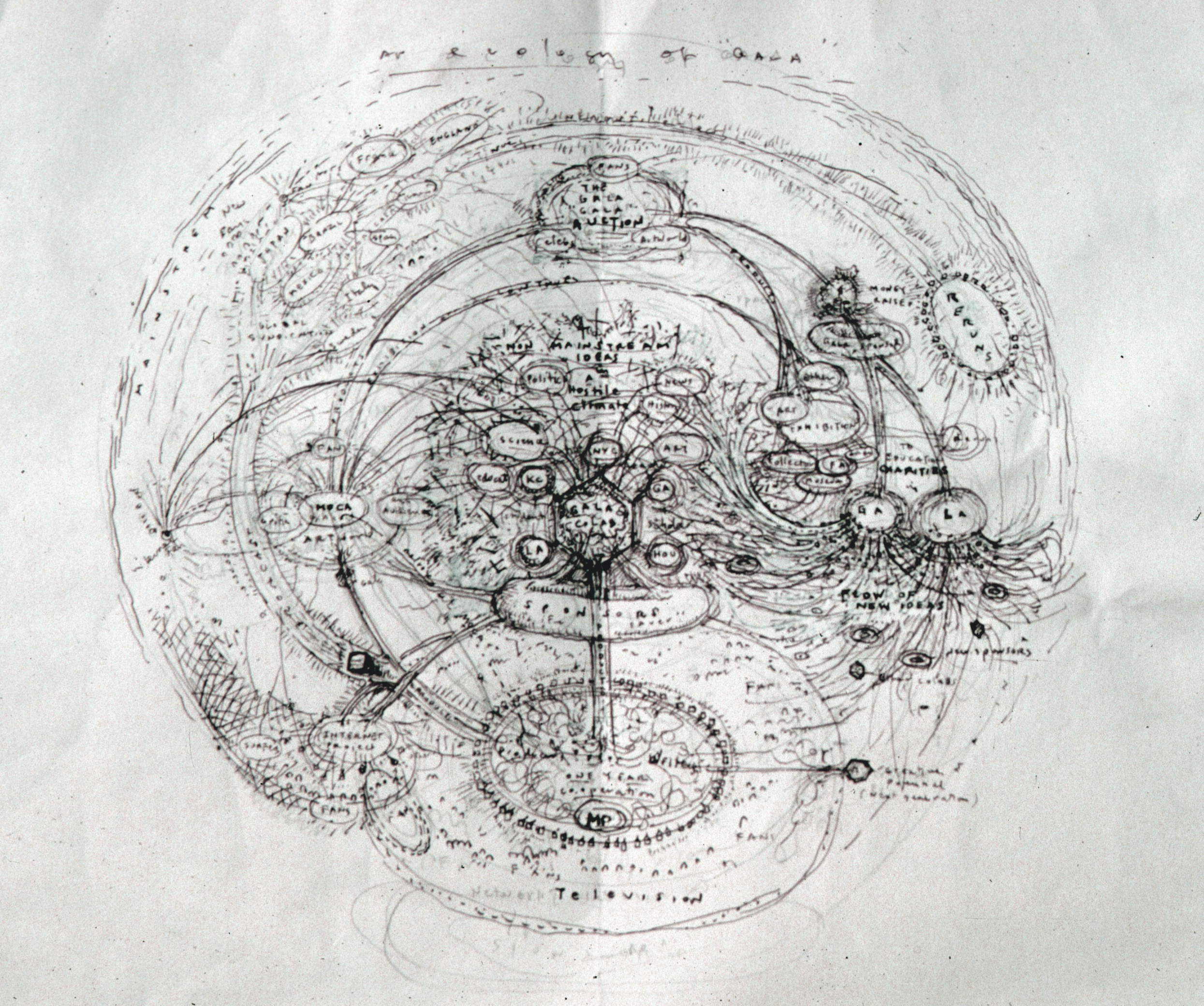
Mel Chin, Ecology of Gala, 1997, graphite pen and ink on drawing paper, 15 x 18 inches
Artist as Political Ecologist
Throughout his career, Chin has assumed the role of political ecologist out of necessity. He has examined how social, economic, and political forces shape environmental realities— not merely for the sake of inquiry but also as a means to realize public work at a scale that matters. This methodology is illustrated by Chin’s drawing of the ecological web The Ecology of Gala (1997) in which his public project In the Name of the Place (1995-1997) operated, showing the synergetic overlaps of art, science, politics, news, and, as it states in the center of the web, “non-mainstream ideas in a hostile climate.”
When asked in an earlier interview whether Revival Field would still succeed as an artwork if the science of phytoremediation proved ineffective, Chin replied, “No, but it can be a successful model of cooperation between disciplines and a guide for navigation through legal, political, and social worlds.”5
Interdisciplinary collaboration is one of Chin’s signature strategies for navigating the halls of power. When a path dead-ends within one discipline, the idea can leap into the open channels of another. Combining traditionally siloed forces can pool available resources, thus expanding possible pathways for a shared vision. Because Chaney’s research was stalled by the Bush administration’s environmental research funding restrictions, Chin set his sights on a $10,000 individual artist grant from the National Endowment for the Arts, which he described as “the one hope I had to get it done.”
Despite Chin’s proposal being approved by peer review and by the National Council of the Arts, the chairman of the NEA at the time, John Frohnmayer, vetoed funding for Revival Field on the grounds of “questionable artistic merit,” arguing that it was “science, not art.”6
Reflecting upon this episode 35 years later, Chin said, “I think they were using me, politically, to say, ‘Let’s show what power does’…. I was not willing to allow that. I was politically aware, in terms of what it meant to have a jury of your peers say ‘yes, you’re okay,’ the presidential council that oversees them say, ‘you’re okay,’ and then an autocrat using public funds say, ‘no.’”
In other words, Chin saw the votes preceding the veto as enough political leverage to work with, if he could just get the autocrat to understand his vision. For Chin, no sounds like not yet.
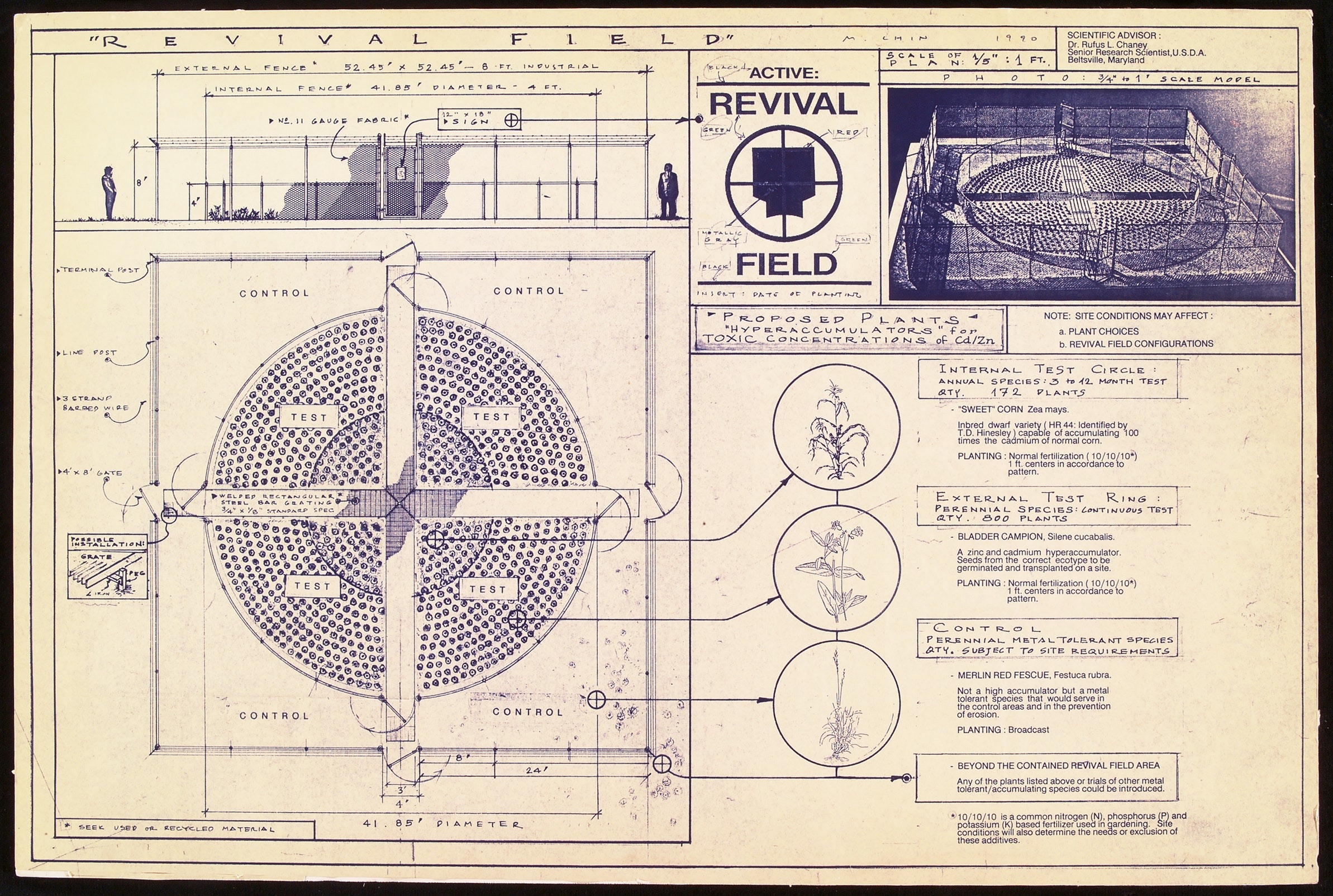
Mel Chin, Revival Field Blueprint, 1990
Artist as Connector
To bridge disciplinary, conceptual, and ideological divides, Chin simply looks for common ground. “Empathy must be used to increase the criticality necessary to launch into all the variables that are required,” Chin said in a 2022 interview. “You listen to people … and then you apply your creative impulse and say, ‘Well, let’s try this.’”7 He has a knack for finding an individual’s humanity within systems designed to erase it.
This approach was central to Chin’s meeting with Chairman Frohnmayer. Chin recounted that he was accompanied by a funder and a museum director. The pair tried the usual levers (friends, political connections, money), but none of them were working and Frohnmayer’s face was turning red. In a huff, he said, “Why don’t you take this to the EPA, not the NEA?” Chin responded, “Because I did, and they won’t take it either.”
Chin then gently shifted the conversation beyond the confines that were framing the debate, into the heart of the matter. He shared what drove him, as an artist and citizen, drawing on Scarry’s philosophy of pain, thereby dissolving the impasse into an invitation to connect over a shared sense of humanity:
I just told him that general rule about what I think: there’s making and unmaking the world. I said, “Whether it’s a duck flying over a pond in a landscape, or it’s a gay man’s blood on a flag, or this project about an invisible aesthetic of something beautiful that you can’t even see—all these things come from this camp of imagination. I just have to ask you, John … which camp are you in?”
Frohnmayer stood up and left the room, and the group feared Chin had blown his chance. A few minutes later, he returned and said, “I just had a graduate-level course. I’m going to rescind my veto.” Chin said, “He admitted that this was the camp that he needed to be in.” Frohnmayer later wrote in his memoir that the meeting shaped “the philosophy that guided me through the rest of my tenure.”8
“So, it was all about negotiating,” Chin explained to me. “But not to just get your way. It’s a way to really understand people and say, maybe you just need to know more.”
Chin repeated this relational approach throughout Revival Field’s realization. A controller offered the warning, “You’re opening a can of worms,” and then hung up the phone. Chin was confronted by the chief counsel of the Minnesota Waste Control Commission, who declared, “I’m here to stop you.” Chin navigated liability and funding obstacles with a mix of relational labor and flexibility—from dinners with congressmen in Washington, DC, to subtle textual compromises, such as replacing “ash” with “cadmium-enriched soil.” Eventually, after moving at the speed of trust, he secured a green light from every stakeholder.
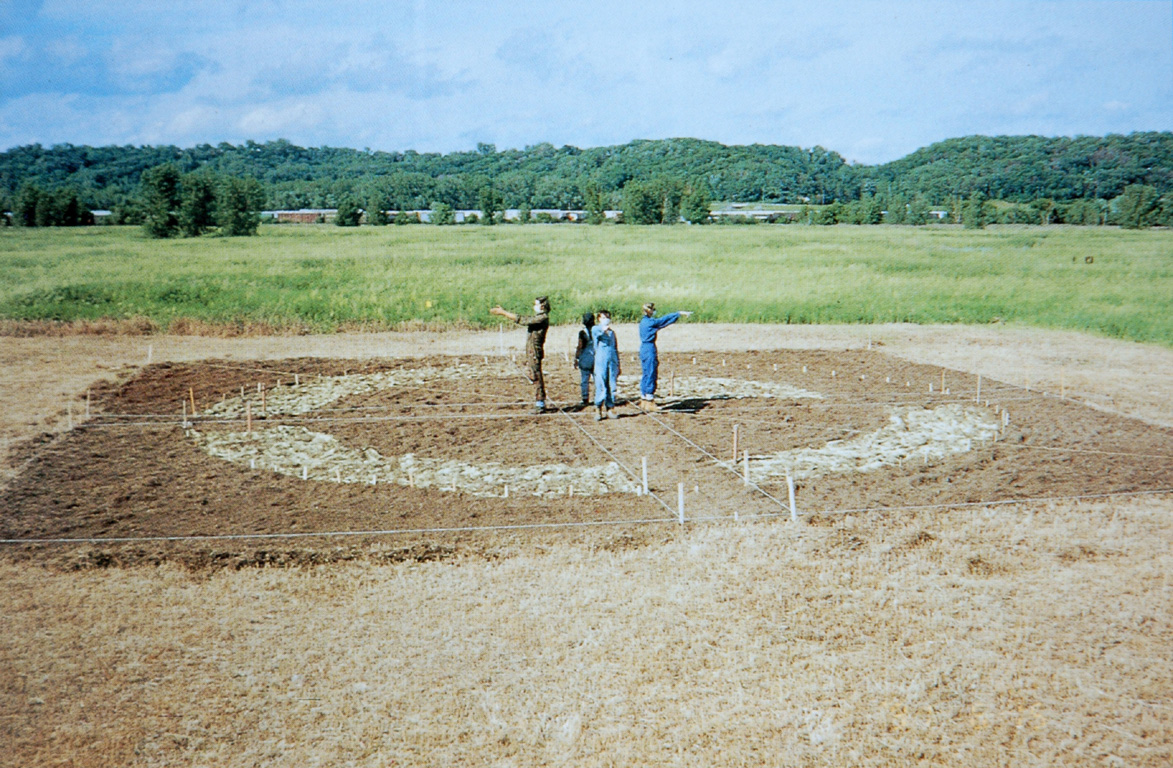
Mel Chin, Revival Field, 1991. Process image. [courtesy of the artist]

Mel Chin, Revival Field, 1991. Pig’s Eye Landfill, St. Paul, Minnesota. Photo documentation of the first harvest on a State Priority Superfund Site. [courtesy of the artist]
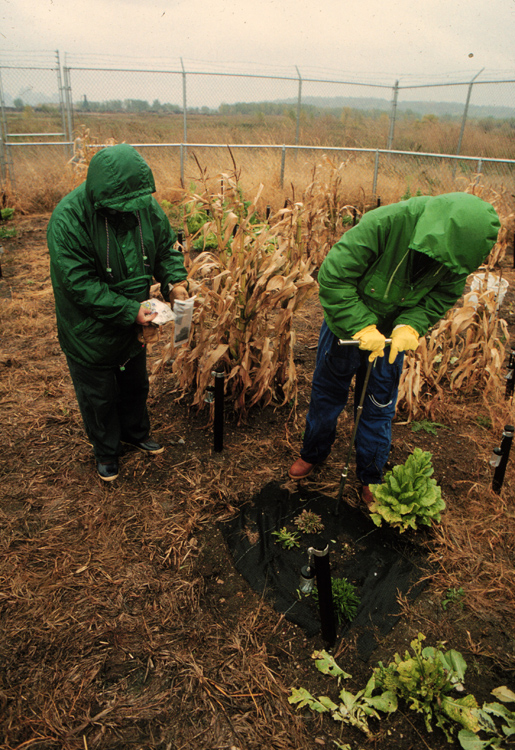
Mel Chin, Revival Field MN: Soil Sampling, 1992
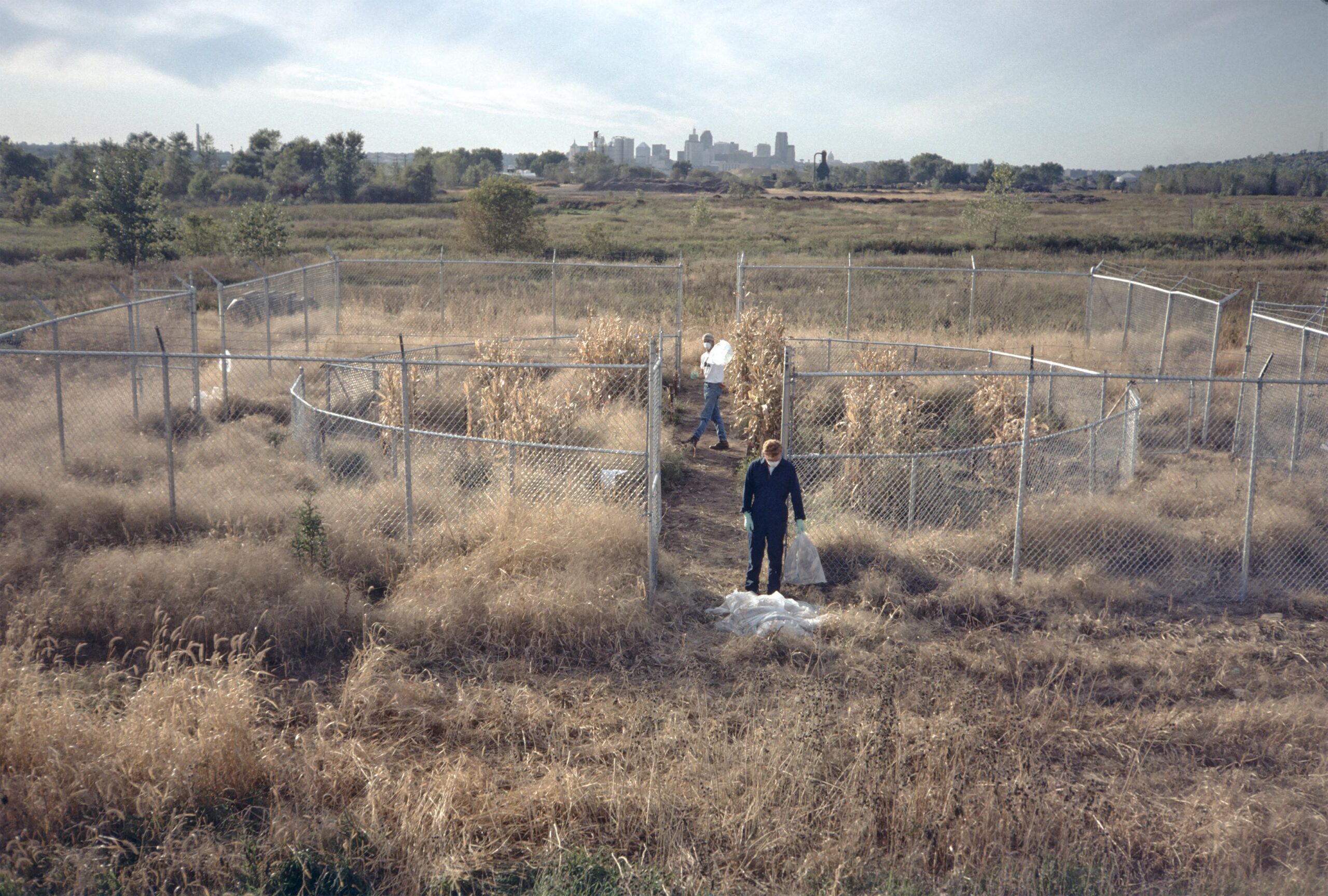
Mel Chin, Revival Field, Harvest at Pig’s Eye Landfill, MN, 1993
Chin reflected that “by not framing and exposing the opposition” in the moment of frustration, he allowed the ecosystem time to understand the project and ultimately to open doors for him later. He advised artists to be “driven by another consciousness that says, ‘It’s okay when people reject things they don’t understand yet. Be empathetic, because they’re doing what the business tells them to do.”
Chin rejects “the notion of the artist as the inventor or the creator in the public practice …. The ego-driven [impulse] must be set aside.”9 Immediately following the NEA chairman’s reversal, Chin recounted that Frohnmayer said, in a very DC fashion, “Okay, now how can we rewrite the press release to make it your fault?” For Chin, the collective goal easily outweighed his own ego.
Reflecting upon that white activist’s advice to him, Chin said, “I think maybe I would add the way you [succeed] is … by being very clear, but very relational …. It’s not just your project. It’s a relationship with people who may be affecting it. It becomes an us project …. Even though she’s saying [to] be solid [in your vision], I’m saying, be flexible—that you can move it to meet other desires and needs, if you can. And then you have more solidarity.”

Mel Chin, Revival Ramp, 1994. Graphite on paper. 34 x 34 in. Private collection.
Artist as Shapeshifter
In his original NEA proposal, Chin framed Revival Field as a conceptual sculpture, describing it as a “reduction process, a traditional method when carving wood or stone. Here the material being approached is unseen and the tools will be biochemistry and agriculture,” an “intended invisible aesthetic.”10
After Frohnmayer’s veto, Chin publicly defended the project’s artistic validity as a sculpture by creating maquettes and diagrams, and by giving interviews. He explained, in a 1991 Village Voice essay, “I’m just tackling something that’s under the ground that you can’t see, but it’s sculptural material; it’s heavy metals. I’m going to carve that with this elegant tool: plants …. The basic sculpturing process is invisible.”11
Decades beyond the funding concerns for Revival Field, Chin now emphasizes that the project’s success as an artwork is more scientific than sculptural: “The most important thing was proving the science, because it created this possibility that had never existed before.” Although he maintains that Revival Field functioned as sculpture, that was never really the point. “If I’m going to call it a sculpture, then let’s not reduce it to just, ‘Oh, plants do this, and there’s the chisel,’ and that kind of language. But it’s also how an action can bring about a shift and shape the medium of discourse.” The idea of sculpture fit the project’s aesthetic and conceptual characteristics, but not its driving vision.
For Chin, emphasizing the work as art, sculpture, or science was strategically flexible, a way to advance the idea’s survival within the linguistic, institutional, and cultural frameworks at the time, thereby expanding their limits. “I would say, we’ll call it sculpture, we’ll call it art, we’ll call it science. I think it’s flexible enough to be whatever you need it to be …. Maybe the terms that we use to describe work should be flexible.”
Chin continued, “I want to think of art as a catalytic structure that creates a platform for the language that has not yet been formed, or the voices that have not yet been heard, and that’s including my own.”
Reflecting on his strategic shapeshifting and tendency to eschew “capital-A Art,” he said:
I don’t have to be an artist if the frame isn’t correct …. But sometimes, it is the correct frame. When the scientist may be overtly critical, you can just say, “Oh, I’m just an artist.” And when the artist’s world is too pushy or misguided, you can just say, “Oh, it’s just a science project ….”
In other words, I believe you have to be active in the world …. If the frame of it creates an ability to make something happen, then just watch where you are …. Hold back on this idea of art. There’s nothing high and mighty. It’s something very human that we’re trying to do.
Chin’s ability to find the right frame and code-switch across disciplines allowed his ideas to remain boundaryless and allowed Revival Field to survive in a world eager to categorize rather than to understand.
Artist as Caretaker
Ideas, like living organisms, require nurturing. Chin explained, “If you have something you really need to do, be ready to mutate. Like Darwin said, become more fit.”12 He continued, “When you catch something that can improve [the idea’s] chances, you take it …. Art projects need to have that capacity, because they have to have a life.”
Few public practice works have achieved such long-term impact across disciplines or embodied the transformative role of the artist as effectively as Chin’s Revival Field. After its first phase concluded successfully in 1993, the project expanded internationally, with new field tests in the Netherlands (1992); Palmerton, PA (1993–1997); and Germany (2000–2001). Each phase further reinforced the practical application of phytoremediation. During the 16th World Congress of Soil Science in 1998, scientists proposed the use of Thlaspi for low-level cadmium remediation, a method validated by Chin and Chaney at the original site. Today, that science is being used for phytomining—that is, extracting minerals from hyperaccumulating plants by smelting them—thereby creating the capital to heal more toxic sites. One of the most effective nickel-sucking plants was recently named after Chaney: Phyllanthus rufuschaneyi.
Chin’s long-term vision for Revival Field’s lifespan is reflected in his 1996 drawing Revival Ramp, which places the field test at a pivotal moment before three diverging paths: two lead toward post-industrial annihilation, while the third leads to ecological stability represented by an evocation of Leonardo Da Vinci’s A Copse of Trees (c. 1500–1510)—also presaged at the pre-industrial start of the temporal ramp. Revival Field is depicted there as an intervening seed, a living cure for a dying earthly body.
“You have to create a condition for an idea to survive,” Chin said in an Art21 interview. “I had to see the big picture of things. If you say, ‘Okay, this has to be completed after I’m dead,’ then what do you need to do to make it work …? It has to prove itself to be self-sustaining.”13
Properly cared for, an idea can survive on its own through changing conditions. Chin said, “It’s the concept that lives. If you want it to live, you have to give it breath. Or, if you can’t do it, please find somebody else to help you.”
It all takes a toll, though. At the end of our visit, Chin added:
You can work so hard and become so debilitated, and the frustrations are so much, you lose a little of yourself because your passions are so strong …. You know how Nietzsche paraphrased the Socratic idea [that] the unexamined life is not worth living? Yeah, I love that. But the world I’m in, with all its mediated content, is there to remove my ability to examine myself.
So, maybe, you can step back and say, well, what kind of tool can I make? And art is one of those tools, you see?
So, it’s still a game, you know? We’re trying, right?
I responded, “Yes, I think a lot of people are still trying.”
“I know. That’s good,” he said. “Thank goodness. Because it’s painful.”
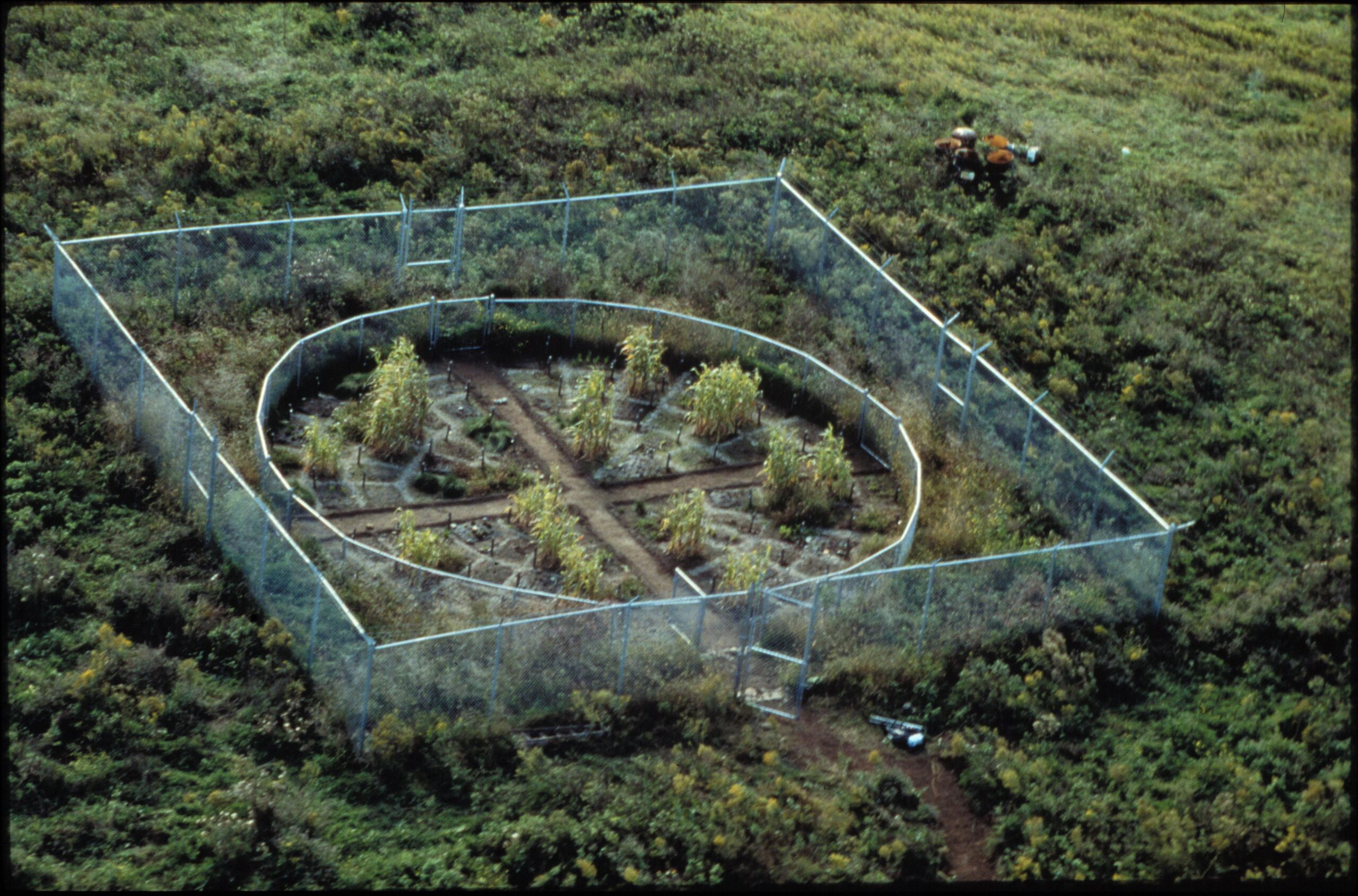
Revival Field, Mel Chin, 1991. Image credit: David Schneider
Heather Bird Harris is an artist, education leader, and independent curator. Her work explores the throughlines between history and ecological crises, engaging with communities, scientists, and place-based research to investigate possibilities for emergence and systems change.
Harris received her B.S. in art history from Skidmore College and master’s degree in education leadership from Columbia University. She has served as the principal of a turnaround school in New Orleans and as a learning consultant for school leaders nationwide, focusing on anti-racist history curriculum. Recent exhibitions include Tiger Strikes Asteroid, NADA Curates, the New Mexico State University Museum, SITE, Stoveworks, the Barnes Ogden Gallery at LSU, Hartsfield-Jackson International Airport, and apexart’s Plastic, the New Coal. She has been a fellow at the Cary Institute of Ecosystem Studies, Hambidge, and the Art & Social Justice Fellowship at Emory University. Harris’s practice has been featured in Burnaway, NPR, Art Papers, and ArtsATL. Recent projects include Sonoran Heritage Waters with musicians and ecologists at Arizona State University and Hope Springs Eternal in collaboration with activist group RISE St. James. She lives in Atlanta, Georgia with her partner Josh and their two children.
References
| ↑1 | Rachel Gugelberger, “How Artist Mel Chin’s ‘Constant Revolution’ Is Tackling Humanity’s Environmental Challenges.” Independent Media Institute, March 2, 2022. |
|---|---|
| ↑2 | Terence McKenna, “The Archaic Revival.” Whole Earth Review, Fall 1989. |
| ↑3 | Mel Chin, “Interview: Revival Field.” Art 21 |
| ↑4 | Mel Chin, “REVIVAL FIELD, 1990,” https://melchin.org (online) https://melchin.org/oeuvre/artist-writing-revival-field/ |
| ↑5 | Mel Chin, “A Composite Interview with Mel Chin,” in Inescapable Histories: Mel Chin, eds. Helen Nagge and Deni McIntosh McHenry, (Kansas City, MO: Mid-American Arts Alliance, 1996), 31. |
| ↑6 | Sally Kuzma, “Myth-Making and Myth Breaking: Multiple Meanings in Mel Chin’s Revival Field,” Art Criticism 10, no. 2 (1994), 84. |
| ↑7 | Rachel Gugelberger, “How Artist Mel Chin’s ‘Constant Revolution’ Is Tackling Humanity’s Environmental Challenges,” Independent Media Institute (March 2, 2022): https://independentmediainstitute.org/2022/03/02/how-artist-mel-chins-constant-revolution-is-tackling-humanitys-environmental-challenges/ |
| ↑8 | John Frohnmayer, Leaving Town Alive: Confessions of an Arts Warrior, (Boston: Houghton Mifflin, 1993): 237. |
| ↑9 | Gugelberger, “Mel Chin’s ‘Constant Revolution.’” |
| ↑10 | Mel Chin, “REVIVAL FIELD, 1990” (accessed December 2023) https://melchin.org/oeuvre/artist-writing-revival-field/ |
| ↑11 | Mel Chin, quoted by Kim Levin in “Eco-Offensive Art,” Village Voice, January 1991, 33. |
| ↑12 | In the first four volumes of Darwin’s On the Origin of Species, he does not use the phrase “survival of the fittest.” He writes, “survival of the fit.” Janine Benyus, biologist and author of Biomimicry, describes this phrasing as meaning “fit to place” and to “changing conditions.” (Krista Tippett, “Janine Benyus: Biomimicry, an Operating Manual for Earthlings,” On Being, March 23, 2023.) |
| ↑13 | Chin, Mel. “Interview: Revival Field.” Art 21 (accessed December 2023). |