Shining, Appy ‘People’—Silvia Park’s Luminous Transpositions
Share:
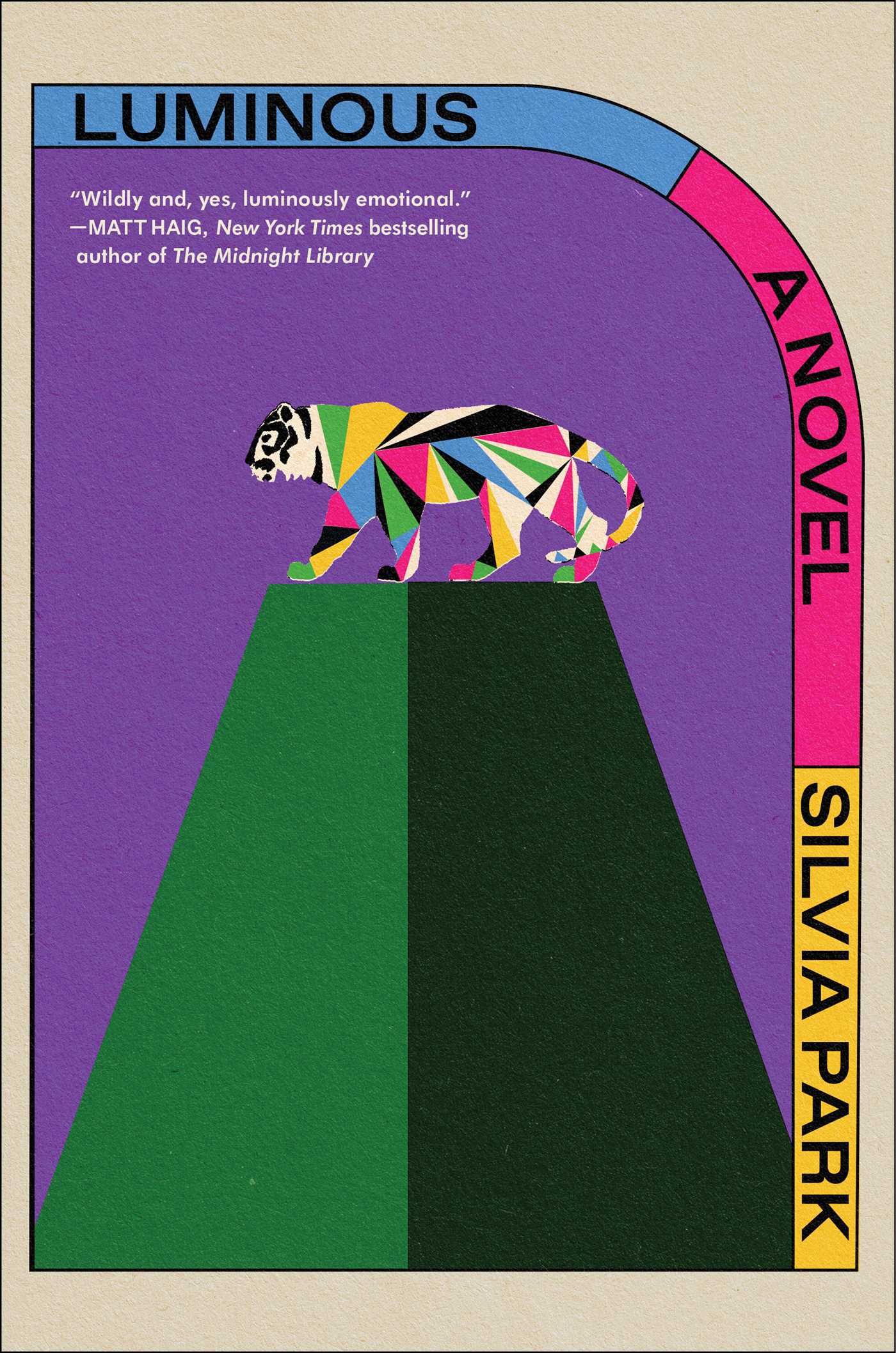
Silvia Park, Luminous, cover, 2025 [courtesy of Simon and Schuster]; jacket art and design by Alex Merto
Decades ago, after realizing that the most poetic titles in the Western canon stem from the King James Version of the bible, many of them from Ecclesiastes, I read from that book of the Old Testament and discovered there a passage that I found jaw-droppingly unexpected: according to his circuits (Eccl. 1:6). With most of my (even now meager) fiction output still ahead of me, I vowed on the spot to write the Great American Robot Novel and to title it with that phrase.
Mercifully, artfully, Silvia Park relieves me of that ambition’s far tougher part with their estimable first novel, Luminous. Set in a near-future Korea re-unified by a horrific war of the tale’s somewhat recent past, Park’s work brings together several narrative strands into an intricate multifamily quilt. In doing so, the author evokes key works by Damon Knight and Philip K. Dick (as well as alluding, outright and repeatedly, to Ridley Scott’s magisterial Dick adaptation) amid lapidary prose that’s often droll and sometimes mesmeric. More impressively, though, Park animates the tug-of-war between pareidolia and paraphilia that would reasonably beset a society populated by androids who can pass for human, humanoid robots that cannot, some humans whose bionic enhancements make them more machine than flesh, and others whose foibles signal a nature too human for comfort.
Luminous has a main plot that seems rudimentary in outline: Famed artist’s “juvenile” fembot goes missing; Robot Crimes division detective’s investigation leads to (sometimes fleeting) contact with various Seoul dwellers, including a perhaps terminally ill schoolgirl, her one-legged android pal, a range of scrapyard salvagers, an estranged sibling, and assorted artificial or technologically altered others. Park’s shifting point of view lends energy aplenty to these encounters. So does the author’s tongue-and-groove style of exposition, which leaves many an imagined detail of life on the Korean Peninsula after the fall of the Hermit Kingdom sensible but blurry at first, and comprehensible only later, once a thing is reperceived through a different character.
Thus, Park’s artistry has a mosaic quality. The first mention of Dolly the Shweep made me wonder whether cloning might also be part of the novel’s milieu. Only later did I realize that this background figure (simultaneously minor and monumental) pays homage to modernity’s most famous ungulate by adding a letter and applying that name to this fictional world’s more sophisticated version of the Roomba. The “Delfi” devices that seem to accompany relative wealth in Luminous clearly relate to augmented vision, yet their limits, ironically, never quite come into focus. Given the breadth and polish of Park’s speculations and the aridity of the author’s wit, I have to see this “lapse” as a sly joke (One that makes perfect sense; how many novels of modernity dwell upon objects so mundane as eyeglasses?).
Furthermore, the author makes the most of language peculiar to fictions that conjure what Samuel R. Delany calls “subjunctive reality.” As Delany notes, phrases that operate only figuratively in mimetic fiction hold more meaning/s outside mimesis. Park’s opening line, “That summer was immortal,” establishes the state of global warming in the story’s setting (bad), flicks at the mindset of the work’s youngest protagonist (angry denial), and sets up the tension at the novel’s heart (the irony of dying young as transhumanism dawns).
Because an android bearing the semblance of a girl detonated a bomb near Jun during the so-called Bloodless War, the character is both a cyborg and male in the novel’s now. In the real world, violence all too often follows gender transition; for Jun, the incident that destroys most of the character’s organic body brings the opportunity for a nigh-lifelong, self-masculating wish to be fulfilled. Jun’s bionic form—legally the property of the Korean military—confuses some people, who mistake the detective for an android, and suffuses one key other with prosthesis envy. Meanwhile, Jun finds the wet meatiness of humanity ever more repellent. Because the character is so emotionally messy, though, Jun selects the wrongest possible companion bot as a sex partner. This choice leads to a dalliance that unfolds over the course of a whole chapter—possibly Park’s most memorable, thanks in large part to two smartass toilets.
Jun’s messiness imbues the character with extraordinary believability. Like the detective’s sister, Morgan, who oscillates “between love and loathing” for their remote roboticist father, Jun approaches almost everyone with intense ambivalence: robots, kinfolk, coworkers, suspects. The narrative echoes this stance. Humans, machines, and the betwixt stare at one another, across the gulf of Uncanny Valley, wanting what they see, wanting to be what they see, wanting to destroy what they see. Various automatons, programmed to lend help and do no harm, often find themselves targeted by people afflicted by that last desire. Misogyny lurks behind—or goads—many of the darkest impulses in Luminous, whether for its bot-bashing incels; for its daughter-resistant fathers; or for its same-sex-attracted male-coded figures, one of whom asks, “Am I a ruined woman?” The novel’s most tender moments stem from its spiky, nigh treacle-free youngsters and, in keeping with Park’s nobody-is-one-thing ethos, an android whose technical classification under the setting’s terminology is “Lethal Autonomous Weapon.”
Yet Luminous also ponders conundrums beyond the merely sociological. Jun and Morgan’s father says to the daughter who followed him into robotics, “You do realize all robots are, in fact, religious.” One of Park’s most arresting images describes a sleeping android whose “eyelids shuddered and … light [slid] underneath, like the flare of a copy machine.” The author inverts the human mechanism of phosphenes, which “shine” inward to ignite dreams, but Park also bestows upon the novel’s automatons a visible “light within,” thus inverting the undetectable human soul. Sometimes, the bots here project a literal halo above their heads, but people who witness the phenomenon disagree on its meaning. Park further complicates the layered Christian iconography here by also associating several of the artificial characters with dokkaebi—tricksters in Korean folklore referred to in one source as possessing a thousand faces and/or, among some subtypes, a single leg or a lone eye.
Luminous closes with a chapter that, amid other allusions, again recalls the aforementioned Blade Runner—specifically, the film’s opening, as a single eye absorbs a hellish view below. Park immediately tempers that imagery with one word: solace. That seesawing of states makes me contemplate the news that framed my writing of this essay. No day passed during the process without my radio spilling forth some reference to artificial intelligence and its resource greed, to drones in warfare or autonomous vehicles on city streets, to one enhanced human exerting wireless remote control over another. Luminous seems—maybe in another of Park’s prosodic japes—agnostic about what our arriving-faster-than-ever future holds. The most and least reassuring wisdom I can share on that front comes from historian Melvin Kranzberg, whose first law tells us that “Technology is neither good nor bad; nor is it neutral.”
As I write these words, hope feels, to me, like yet another dwindling resource in the world. Nonetheless, hope remains free to anyone who can hold onto it. If I suppress my own feelings about the future, I can hope to read a novel that outdoes Luminous at bringing to dramatic life the myriad vagaries of technology in our lives, but I confess that doing so feels akin to praying for a miracle.
Postscript: Barring the unforeseen, this review will be the last thing I write for ART PAPERS as it traverses its Fire Ecology phase. Weirdly, during my first reading of Luminous, I breezed right past imagery invoking that wildfire-related phenomenon (“He poured [boiling water] on the mangled skyn. It began to grow back …. Like the accelerated rejuvenation of a burnt forest …”). My intent with this review always entailed my letting go of that potential title I found, long ago, in Ecclesiastes, so the oversight constitutes my missing the forest metaphor because of the plank in my mind’s eye. Thus, do with those four words as you please.
Edward Austin Hall co-created Hunter: The Reckoning in 1999 for White Wolf Game Studio and recently contributed to that roleplaying game’s fifth edition; his game writing also appears in Blackbirds (Andrews McMeel, 2022). He co-edited the 2013 anthology Mothership: Tales from Afrofuturism and Beyond, a book acknowledged in a front-page NPR.org story headlined “Sci-Fi Has Changed A Lot In The Past Decade—These 7 Reads Will Show You How.” Gumbohaus published Dread Isle, Hall’s first novel, in 2020. His new novelette, Green Treacheries, appears in a just-released anthology of Atlanta-set fantastical fictions called Terminus 2.